RIX Titan-T3 Thermal Monocular LRF review is for buyers who want a compact thermal viewer with ranging built in.
It stands out because it combines a 25mm thermal optic, a 384×288 sensor, and a laser rangefinder in one handheld unit.
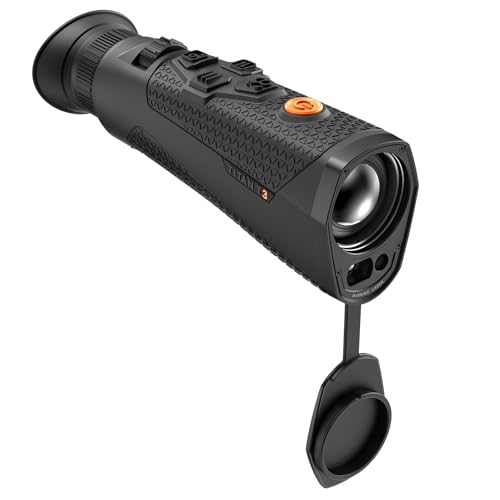
Titan-T3 Review Summary
The RIX Titan-T3 Thermal Monocular LRF is best for hunters, land managers, and security-minded users who want more than a basic thermal spotter.
The listing points to a feature-rich package: thermal imaging, integrated laser ranging, ballistic calculation, a high-resolution OLED display, and stabilization tools that are meant to make handheld use easier.
Verdict: it looks strongest for buyers who value target identification, distance awareness, and a cleaner viewing experience over minimalism.
If you want one device that can help you scan, estimate range, and stay steadier while moving, this is a compelling option.
If you want the simplest possible thermal monocular, it may be more than you need.
Review Scorecard
| Category | Score | Rationale |
|---|---|---|
| Thermal imaging usefulness | 9 | 384×288 resolution and 12μm pitch give it a serious core imaging spec for a handheld monocular. |
| Rangefinding value | 10 | The integrated LRF is a major advantage for buyers who need distance data without carrying a separate tool. |
| Display quality | 9 | The 1920×1080 OLED display is a standout differentiator versus lower-resolution screens. |
| Field usability | 8 | One-hand operation and ergonomic controls should help in practical outdoor use. |
| Stability while moving | 8 | Built-in EIS is a meaningful support feature for handheld scanning or vehicle vibration. |
| Feature depth | 9 | Ballistic calculation and RET zoom enhancement make it unusually capable on paper. |
| Simplicity for beginners | 6 | The feature set is rich, but that also means a steeper learning curve than a basic thermal unit. |
Key Features and Specifications of Titan-T3
The Titan-T3 is built around a 25mm objective lens and a 384×288 thermal sensor.
The listing also specifies a 12μm pixel pitch detector, a 1920×1080 0.49-inch OLED display, and NETD below 20mK, which together suggest a strong emphasis on detail and display clarity.
Its detection range is listed up to 1421 yards, while the integrated laser rangefinder can measure distances up to 1312 yards.
That split matters: detection and ranging are not the same thing, and this product appears designed to help with both.
Other listed features include:
- F0.9 lens design to gather more light than a typical F1.0 lens
- One-hand operation with a focus wheel near the eyepiece
- Button placement intended to be easy to find by touch
- Electronic image stabilization to reduce shake and blur
- RET technology that uses AI-assisted enhancement during digital zoom
- Free integrated ballistic calculation
For buyers comparing thermal monoculars, the most important takeaway is that this is not just a sensor in a tube.
It is a bundled observation tool with display, stabilization, ranging, and digital processing layered on top of the core thermal image.
Pros and Cons of Titan-T3
Pros
- Integrated laser rangefinder reduces guesswork in the field
- High-resolution OLED display should make fine detail easier to see
- Ballistic calculator adds utility for hunting-oriented use
- EIS is useful when scanning while walking or riding in a vehicle
- One-hand layout sounds practical for real outdoor handling
- RET zoom enhancement is positioned to preserve clarity better than basic digital zoom
Cons
- The feature set may be more complex than some buyers want
- A 384×288 thermal core is capable, but not the absolute top tier for maximum detail
- The listing language suggests a strong hunting orientation, so casual users may be paying for tools they never use
- As with any thermal monocular, performance will still depend on conditions and user skill
Who Should Buy Titan-T3?
Buy the Titan-T3 if you want a thermal monocular that does more than simply show heat signatures.
It makes sense for hunters who care about distance awareness, for property owners checking perimeter activity, and for users who want a compact handheld with built-in ranging and stabilization.
It also fits buyers who dislike juggling separate tools.
If you regularly estimate distances, scan from a moving position, or want a higher-end viewing interface, the Titan-T3 offers a concentrated set of features in one device.
You should probably skip it if you only need occasional short-range thermal spotting, or if you prefer the simplest possible interface.
The rangefinder, ballistic calculator, enhancement modes, and stabilization tools are useful, but they also make the device more specialized than a bare-bones thermal monocular.
Image and Rangefinding Behavior of Titan-T3
Thermal Detail at the Core
The listed 384×288 resolution and 12μm pitch put the Titan-T3 in a serious handheld thermal category.
That does not make it magical, but it does mean the device is built to do real work rather than serve as a novelty viewer.
OLED Display Matters Here
The 1920×1080 OLED display is one of the strongest listed selling points because it can affect the experience as much as the sensor does.
A better screen can make scanning easier, especially when you are trying to separate shapes, edges, and heat sources in the dark.
Range Data Changes Decisions
The built-in laser rangefinder and ballistic calculator are the features that move this from a simple viewer to a more decision-oriented tool.
For hunting and field observation, knowing what you are seeing and roughly how far away it is can matter as much as raw detection.
Stabilization and Zoom Are Practical Additions
EIS and RET zoom enhancement are not headline features for every shopper, but they solve real handheld problems.
Shake, blur, and pixelation are common pain points with compact thermal devices, so even a modest improvement here can make the Titan-T3 feel more usable in the field.
Alternatives to Titan-T3
If you want other thermal monocular options to compare, look at the AGM thermal monocular line, the Pulsar Axion series, and the FLIR thermal monocular line.
Those alternatives are worth checking because they give you different balances of sensor class, ergonomics, and feature depth.
AGM often appeals to buyers who want practical field gear, Pulsar is a common benchmark for premium thermal spotting, and FLIR remains a familiar name for compact thermal imaging.
Is Titan-T3 Worth It?
The RIX Titan-T3 Thermal Monocular LRF is worth considering if you want a feature-rich thermal handheld with built-in ranging, a high-resolution OLED display, and tools aimed at real field use.
It is especially attractive for hunters and serious outdoor users who will actually use the rangefinder, stabilization, and ballistic features.
If you only need basic thermal spotting, it may be more device than necessary.
But for buyers who want one compact tool that combines detection, display quality, distance awareness, and handheld usability, the Titan-T3 looks like a well-targeted buy.