The best car inverters with digital displays make it easier to power and charge electronics while keeping an eye on your vehicle’s voltage. This roundup covers compact plug-in models and higher-output units for road trips, work vehicles, trucks, and RV use.
We compare output capacity, waveform, charging ports, display features, connection methods, and practical safety considerations so you can choose an inverter that matches your vehicle and devices.
Best 10 Car Inverters with Digital Displays Picks for 2026
Best High-Power Option

- 3000W continuous and 6000W peak output
- Color LED provides detailed operating data
- Wireless remote and multiple safety protections
Best For: RV, worksite, and emergency high-load applications
Best Remote-Monitoring Pick

- 1500W pure sine wave output with 3000W surge
- 15-foot wired remote with LED monitoring
- Three AC outlets plus USB and 30W PD charging
Best For: Remote monitoring in trucks, RVs, and job sites
Best Compact Road-Trip Pick

- Compact 300W design for vehicle use
- LCD monitors input and output voltage
- Two AC outlets plus four fast USB ports
Best For: Road trips, laptops, phones, and modest in-car loads
Best Overall 500W Option

- 500W continuous, 1,000W peak output
- LCD shows voltage, battery status, and fault codes
- Two AC outlets with USB and USB-C charging
Best For: Road trips, mobile offices, and camping
Best Compact Charging Hub
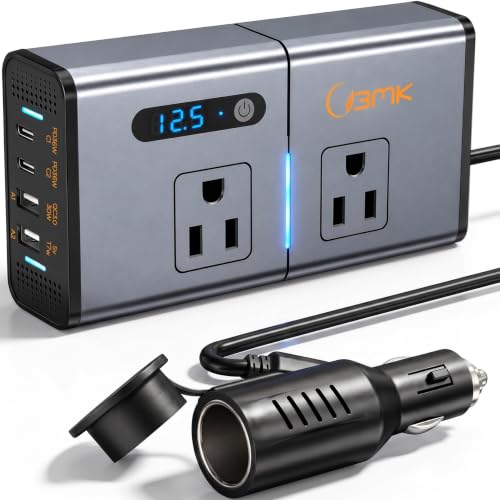
- Seven power connections in a compact design
- Dual 36W USB-C and QC 3.0 charging
- LED display monitors vehicle input voltage
Best For: Commuters and road-trip device charging
Best High-Output Choice

- 3,000W continuous and 6,000W surge capacity
- LCD tracks voltage, battery, load, frequency, and faults
- Four AC outlets, four USB ports, and remote control
Best For: RV, truck, boat, and emergency battery systems
Best Value Displayed Power

- 750W continuous and 1000W peak output
- Dual AC outlets with QC 3.0 and 30W USB-C
- Digital display and multiple safety protections
Best For: Camping, emergencies, and everyday vehicle charging
Best Compact Display

- Compact 5.5-inch design weighs about 10 ounces
- Two AC outlets and four USB charging ports
- 65W USB-C with voltage display and safety protections
Best For: Everyday phone, tablet, and laptop charging in a car
Best Pure Sine Wave Pick – 1000W BESTEK Inverter
For shoppers comparing car inverters with digital displays, the BESTEK 1000W model stands out for its pure sine wave output, two AC outlets, dual USB ports, and status-monitoring LCD. It is designed for powering sensitive electronics and selected small appliances from a 12V vehicle battery.
Best For: Users who want clean power for electronics, CPAP equipment, and small appliances during travel or outages.
Pros:
- Pure sine wave output is suitable for sensitive devices and can reduce electrical noise.
- LCD shows input/output voltage, output power, and protection status.
- Provides 1000W continuous power, two AC outlets, and two 4.8A USB ports.
- Includes cooling fan control, multiple protections, and an 18-month warranty.
Cons:
- Its 1000W capacity is not intended for the heaviest high-demand appliances.
- At 4.3 pounds, it is less compact than small plug-in vehicle adapters.
The BESTEK is a practical balance of clean output, useful monitoring, and moderate capacity. Its digital LCD makes it easier to track operating conditions before connecting more demanding loads.
Best High-Power Option – TOPBULL 3000W Inverter
This TOPBULL model is one of the more powerful car inverters with digital displays, converting 12V DC to 110/120V AC at 3000W continuously with up to 6000W peak output. Its color LED display and wireless remote provide useful visibility and control for RVs, worksites, and emergency setups.
Best For: RV users, construction applications, and emergency power systems needing substantial 12V-to-AC capacity.
Pros:
- 3000W continuous and 6000W peak output support demanding loads.
- Color LED display shows battery charge, output power, input voltage, fan status, and frequency.
- Includes two 20A AC outlets, USB fast charging, and a 30W Type-C port.
- Offers wireless remote control, dual smart fans, and extensive safety protections.
Cons:
- Its high-power design is more than many basic car charging needs require.
- Requires suitable 12V or 12.8V battery connections rather than a simple low-power plug-in setup.
With heavy-duty output, remote operation, and detailed display information, the TOPBULL is suited to fixed or semi-permanent battery systems. Buyers should match the inverter to an appropriately capable battery and installation.
Best Remote-Monitoring Pick – LANDERPOW 1500W Inverter
The LANDERPOW 1500W unit combines pure sine wave output with a remote LED screen, making it a strong choice among car inverters with digital displays for trucks, RVs, and job sites. It supplies 1500W continuously, with 3000W surge capacity, and includes several AC and USB charging options.
Best For: Drivers and campers who want to monitor battery levels, output, and errors from a remote location.
Pros:
- Pure sine wave output is designed to protect sensitive electronics and reduce hum or flicker.
- 15-foot wired remote displays battery levels, output, and errors in real time.
- Three AC outlets plus USB and 30W PD ports support multiple devices.
- Includes thick 4AWG cables, protective features, a metal shell, and three-year coverage.
Cons:
- It needs a direct 12V battery connection with included cables rather than a standard accessory socket.
- The larger 1500W system may be unnecessary for light phone or laptop charging.
The LANDERPOW is especially convenient when the inverter is mounted away from the driver or campsite. Its remote display adds practical control while the pure sine wave output broadens device compatibility.
Best Compact Road-Trip Pick – BMK 300W Car Inverter
For everyday travel charging, this BMK adapter is a compact option among car inverters with digital displays. It converts vehicle 12V power to 300W of 110V AC output and adds two switched AC outlets, two USB-C PD ports, and two USB-A QC3.0 ports.
Best For: Road trips and vehicle users charging laptops, phones, tablets, CPAP machines, or other modest loads.
Pros:
- Compact stackable design fits conveniently in a vehicle console.
- LCD voltage display provides real-time input and output monitoring.
- Two AC outlets have independent switches to help reduce unnecessary battery drain.
- Fast charging includes two 36W USB-C PD ports and two QC3.0 USB-A ports.
Cons:
- Its 300W output is not suitable for high-demand appliances.
- It is intended for a vehicle DC power socket, limiting it to compatible in-car use.
The BMK focuses on convenience rather than maximum wattage. Its compact body, switched outlets, fast USB charging, and LCD voltage readout make it a sensible choice for everyday vehicle power needs.
Best Overall 500W Option – 500W LCD Car Power Inverter
For shoppers comparing car inverters with digital displays, this 500W model offers a useful balance of output, connectivity, and monitoring. Its LCD shows input voltage, output voltage, battery status, and protection codes, while the included car plug and battery clips support different power levels.
Best For: Road trips, mobile work, camping, and powering laptops or other small electronics from a 12V vehicle system.
Pros:
- 500W continuous output with 1,000W peak capacity.
- LCD provides real-time electrical readings and troubleshooting codes.
- Two AC outlets plus USB and 36W USB-C charging.
- Includes multiple safety protections and both car-plug and battery-clip connections.
Cons:
- The cigarette-lighter connection is limited to 150W; higher loads require direct battery connection.
- Modified sine wave output is not recommended for certain sensitive or motor-driven appliances.
This is a practical midrange choice when you want more capacity than a basic car adapter and a display that explains operating or protection conditions. Keep loads within the connection limits and appliance compatibility guidance.
Best Compact Charging Hub – 200W LED Car Power Inverter
This compact option stands out among car inverters with digital displays for its seven power connections and small footprint. The LED display tracks vehicle input voltage, while USB-C PD, QC 3.0, AC, and pass-through 12V outputs support several devices during commutes or trips.
Best For: Travelers who primarily use a 12V accessory socket to charge phones, tablets, laptops, and other modestly powered electronics.
Pros:
- Seven connections include two AC outlets, two USB-C ports, two USB-A ports, and a 12V socket.
- Two USB-C ports support up to 36W each, with QC 3.0 USB-A charging up to 30W.
- LED display shows real-time vehicle input voltage.
- Separate AC switch and temperature-controlled cooling fan add convenience.
Cons:
- Total output is limited to 200W.
- Uses modified sine wave AC output.
- Its display reports input voltage rather than a broader set of operating readings.
Choose this model when charging flexibility and compact size matter more than high-wattage AC power. It is especially convenient for mixed USB and laptop charging from a standard vehicle socket.
Best High-Output Choice – Cantonape 3000W LCD Inverter
For buyers seeking car inverters with digital displays and substantially higher capacity, this Cantonape unit provides 3,000W continuous output and 6,000W surge power from a 12V battery system. Its LCD reports input and output voltage, battery capacity, load capacity, frequency, and abnormal-condition codes.
Best For: Battery-based RV, truck, boat, camping, emergency, and outdoor setups needing multiple AC outlets and high continuous capacity.
Pros:
- 3,000W continuous and 6,000W surge output.
- LCD displays voltage, battery capacity, load, frequency, and fault codes.
- Four AC outlets and four USB ports support multiple devices.
- Includes remote control, battery cables, cooling fan, and six listed protection functions.
Cons:
- Requires a suitable 12V battery setup rather than a standard cigarette-lighter socket.
- Modified sine wave output may not suit every appliance.
- The remote requires a 12V 23A battery, which is not included.
This is the capacity-focused pick in the group, but its 12V battery requirements make it less convenient for casual plug-in car use. The detailed LCD and remote control are valuable for larger battery-powered installations.
Best Value Displayed Power – TWING 1000W Car Inverter
For shoppers comparing car inverters with digital displays, the TWING 1000W model offers a practical balance of vehicle charging ports and moderate AC capacity. It provides 750W of continuous power, 1000W peak power, dual AC outlets, QC 3.0 USB charging, and a 30W USB-C port.
Best For: Camping, vehicle emergencies, and charging several small electronics from a car or 12V battery.
Pros:
- Digital display helps monitor inverter operation.
- Includes two AC outlets, QC 3.0 USB, and 30W USB-C charging.
- Offers protection against overvoltage, low voltage, overload, short circuits, and overheating.
- Can connect through a cigarette lighter or directly to a 12V battery.
Cons:
- Uses a modified sine wave rather than a pure sine wave.
- Continuous output is 750W, despite the 1000W peak rating.
- Requires a well-ventilated, dry operating area.
This is a flexible choice when you want a digital display and multiple charging options without moving to a larger high-output inverter. Keep connected loads within the rated capacity and use the battery cables for higher-demand applications.
Best High-Output Display – MOVFFGGRM 3000W Inverter
If you need car inverters with digital displays for heavier 12V loads, this MOVFFGGRM model stands out with 3000W of continuous output and 6000W peak power. Its LCD display is paired with four AC outlets, four USB ports, and an 18W USB-C quick-charge port.
Best For: Trucks, RVs, and demanding setups using tools, appliances, game consoles, or multiple electronics.
Pros:
- Provides 3000W continuous and 6000W peak output.
- Includes four AC outlets, four 2.4A USB ports, and 18W USB-C charging.
- LCD digital display provides visible operating information.
- Aluminum body and silent fan support heat dissipation.
Cons:
- Its modified sine wave output may not suit every sensitive device.
- The larger 17.5-inch body is less portable than compact car inverters.
- Loads from 1600W to 3000W must use the high-power output terminal.
This model is best suited to buyers who prioritize output capacity and plentiful ports over compact size. Confirm your vehicle or battery setup can support the intended load, and follow the high-power terminal guidance for larger demands.
Best Compact Display – 200W Car Inverter with USB-C
For a compact option among car inverters with digital displays, this 200W adapter combines a cigarette-lighter connection with two AC outlets, four USB ports, and a 65W USB-C port. Its small 5.5-by-3-by-1.4-inch design is intended for convenient in-car charging.
Best For: Drivers who need a lightweight charger for laptops, phones, tablets, and other modest-power electronics.
Pros:
- Compact, lightweight design is easy to carry and store.
- Provides two AC outlets, four USB ports, and 65W USB-C charging.
- Voltage display makes operating status easy to check.
- Protection features address overheating, undervoltage, overvoltage, overload, and short circuits.
Cons:
- 200W capacity is intended for smaller electronics, not high-demand appliances.
- Its cigarette-lighter format limits use to compatible vehicle outlets.
- Supplied notes do not specify the waveform or continuous-versus-peak output details.
This is the most convenient pick for everyday passenger-car charging where portability matters more than high wattage. Check the requirements of each device before connecting it, particularly laptops and other higher-draw electronics.
How We Picked These Car Inverters with Digital Displays
We focused on 12V vehicle inverters offering useful combinations of AC outlets, USB charging, and an LCD or LED voltage display. The selection includes compact cigarette-lighter models for phones and laptops, as well as higher-wattage units designed for direct battery connection and heavier loads.
We also considered rated output, advertised peak power, pure sine wave availability, USB-C charging, cooling and protection features, portability, and the kinds of devices each format can reasonably support. Always verify the manufacturer’s specifications before connecting sensitive or high-draw equipment.
Quick Comparison
- Compact 200W–300W models: Best for phones, tablets, cameras, small laptops, and other modest loads.
- 500W–1,000W models: Better for multiple devices, larger laptop chargers, portable equipment, and short-duration medium loads.
- 1,500W–3,000W models: Intended for demanding equipment, but usually require direct battery wiring rather than a standard 12V accessory socket.
- Pure sine wave models: The safer choice for sensitive electronics, motor-driven devices, medical equipment, and appliances that may react poorly to modified sine wave output.
Key Buying Factors for Car Inverters with Digital Displays
Continuous Wattage Matters Most
Use the continuous output rating—not the brief peak rating—to match your equipment. Add the running wattage of everything you plan to use, then leave headroom for startup surges. A high peak number does not mean an inverter can sustain that load.
Check the Connection Method
Accessory-socket models are convenient but are commonly limited by the vehicle socket’s fuse and wiring. High-output inverters should generally connect directly to the battery with correctly sized cables and an appropriate fuse. Follow the included instructions and never exceed the vehicle’s electrical limits.
Use the Display as a Warning Tool
An LCD or LED display can show input voltage and help identify a weak battery, excessive load, or charging problem. It is useful for monitoring, but it does not replace a proper battery monitor or alternator test.
Match the Ports to Your Devices
Count the AC outlets and USB ports you actually need. USB-C Power Delivery can charge compatible phones, tablets, and laptops faster than basic USB-A, while QC support is useful only when the connected device and cable are compatible.
Who Should Buy Which Car Inverters with Digital Displays?
Choose a 200W or 300W inverter for everyday travel charging, navigation gear, cameras, tablets, and small laptops. These models are generally the easiest to use from an accessory socket.
Choose a 500W or 1,000W model if you need more outlets or plan to run several moderate devices at once. Confirm the socket and wiring can safely support the intended load.
Choose a 1,500W or 3,000W inverter for substantial loads only when you can install it correctly with direct battery connections, suitable cabling, ventilation, and adequate battery capacity. For sensitive or expensive electronics, prioritize a pure sine wave design over maximum advertised wattage.