The best car head-up displays for road trips keep essential information in your line of sight, helping you check speed, directions, and alerts without repeatedly looking down at the dashboard. The right model can make long-distance driving feel more convenient while adding useful information to vehicles with limited built-in technology.
This roundup includes compact GPS speedometers, OBD2 diagnostic displays, windshield projectors, and wireless CarPlay or Android Auto units. Use the buying guide below to match screen size, installation method, compatibility, and features to the way you travel.
Best 10 Car Head Up Displays for Road Trips Picks for 2026
Best Feature-Rich GPS HUD
G12 Multifunctional Car Head-Up Display

- Shows speed, mileage, time, direction, and coordinates
- Offers more than ten configurable display combinations
- USB plug-and-play setup with rotating bracket
Best For: Drivers who want detailed GPS trip data
Best Connected HUD
Wireless CarPlay and Android Auto Display

- Adds wireless CarPlay and Android Auto
- Combines navigation, calls, music, and speed alerts
- Uses an anti-glare screen with adaptive brightness
Best For: Connected drivers using smartphone navigation
Best Simple Windshield HUD

- Projects simple speed data onto the windshield
- Includes overspeed and fatigue-driving alerts
- Supports MPH/KM/H with automatic brightness
Best For: Drivers who prefer a minimal speed display
Best Large-Screen Smart HUD
VIVIHUD V3-SE Wireless CarPlay Display

- Adds wireless CarPlay and Android Auto to older vehicles
- Supports maps, music, calls, messages, and voice assistants
- HD anti-reflection display with adjustable viewing angle
Best For: Road trippers upgrading vehicles without built-in CarPlay
Best GPS Speed Visibility

- Dual GPS + BDS positioning with 10Hz refresh
- Large MPH display with automatic brightness
- USB powered without an OBD port
Best For: Road-trippers wanting a simple, readable GPS speed display
Best Vehicle Data Monitor
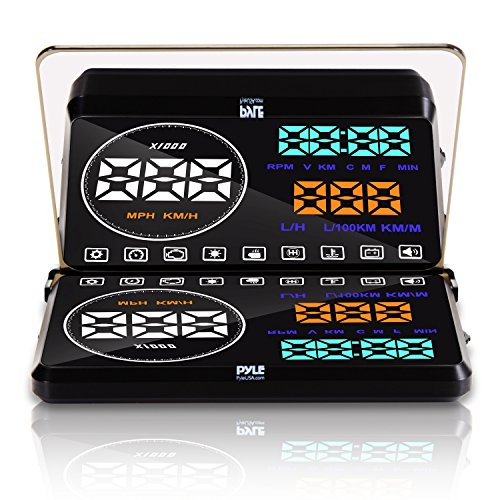
- Shows speed, RPM, temperature, voltage, and fuel data
- Includes multiple driving and engine alerts
- OBDII/EUOBD plug-and-play installation
Best For: Compatible vehicles needing speed plus onboard diagnostic information
Best Compact USB Road-Trip HUD
- Compact 1.6-ounce USB-powered design
- Large MPH readout with anti-reflective shading
- Automatic brightness and GPS + BDS positioning
Best For: Travelers wanting a portable, no-OBD speed HUD
Best Overall Data Display

- Large 5.5-inch display with auto brightness
- Shows speed and multiple vehicle readings
- Plug-and-play OBD2 diagnostics
Best For: Road trippers wanting speed and vehicle-status information
Best GPS Accuracy Features

- 10 Hz GPS+BDS signal reception
- USB plug-and-play installation
- Calibration and overspeed alert functions
Best For: Drivers seeking a simple, readable GPS speed display
Best Simple USB Option
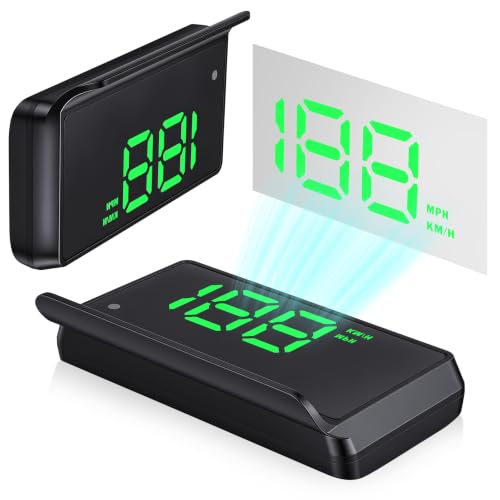
- No-OBD USB installation
- Large high-contrast speed digits
- Automatic brightness adjustment
Best For: Drivers wanting a simple speed display for varied vehicles
Best Feature-Rich GPS HUD – G12 Multifunctional Car Head-Up Display
If you want car head up displays for road trips that show more than speed, the G12 offers a broad set of GPS-based driving data in a large 5.5-inch display. Its USB plug-and-play setup and adjustable mounting options make it a practical choice for adding trip information without modifying the vehicle.
Best For: Drivers who want speed, mileage, direction, time, alerts, and other trip data in one configurable display.
Pros:
- Displays speed, time, driving time, mileage, direction, coordinates, and more.
- Offers more than ten display combinations for personalized viewing.
- Uses GPS and Beidou dual-mode positioning for satellite searching.
- Includes a 360-degree rotating bracket and one-year warranty.
Cons:
- The plastic unit adds more dashboard hardware than a minimalist speed-only HUD.
- It requires a USB connection for power.
The G12 is a versatile road-trip companion for drivers who prefer detailed trip information and flexible screen layouts. Choose it over a simpler HUD when mileage, direction, and driving reminders are priorities.
Best Connected HUD – Wireless CarPlay and Android Auto Display
For car head up displays for road trips that also support navigation, calls, and media, this 2.99-inch connected HUD combines wireless CarPlay and Android Auto with speed and GPS alerts. Its anti-glare screen, adaptive brightness, and grippy silicone base are useful for changing light and uneven road conditions.
Best For: Connected road trippers who want smartphone navigation, hands-free calling, voice control, and media access on a dedicated dashboard display.
Pros:
- Supports wireless Apple CarPlay and Android Auto through Bluetooth connectivity.
- Provides GPS guidance, speed alerts, calls, media streaming, and voice commands.
- High-luminance anti-glare display includes adaptive brightness.
- Non-slip silicone base is designed to stay steady during turns and braking.
Cons:
- The 2.99-inch screen is smaller than some dedicated GPS HUD displays.
- Wireless smartphone features depend on a compatible phone and connection.
This model is a strong fit when a road-trip HUD needs to do more than display vehicle data. Its main appeal is the combination of smartphone connectivity and a compact, sunlight-readable dashboard screen.
Best Simple Windshield HUD – M1 GPS Speedometer
The M1 is a straightforward option for car head up displays for road trips, projecting essential speed information onto the windshield without crowding the driver’s view. It uses GPS, adjusts brightness automatically, and includes overspeed and fatigue-driving alerts.
Best For: Drivers who want a simple speed-focused display with direction, brightness adjustment, and basic safety reminders.
Pros:
- Focuses on clear speed information rather than a crowded data layout.
- Supports both MPH and KM/H, with a GPS compass for direction.
- Includes overspeed and continuous-driving fatigue alerts.
- Plug-and-play USB installation with automatic brightness adjustment.
Cons:
- Speed appears only after the device acquires GPS satellites.
- Satellite searching may be slower near buildings, in garages, or with metal window film.
- It does not provide smartphone navigation or media features.
The M1 makes sense for buyers who value minimal distraction and quick access to speed. Its simple presentation is well suited to long drives, provided the installation location allows reliable GPS reception.
Best Large-Screen Smart HUD – VIVIHUD V3-SE Wireless CarPlay Display
For road trips in vehicles without built-in smartphone integration, the VIVIHUD V3-SE combines wireless CarPlay and Android Auto with an HD display, Bluetooth audio, screen mirroring, and GPS speedometer functions. Its adjustable viewing angle and non-slip base help it remain practical across cars, SUVs, pickups, vans, and RVs.
Best For: Drivers seeking a portable smart display for navigation, calls, music, and smartphone integration in older or unequipped vehicles.
Pros:
- Provides wireless Apple CarPlay and Android Auto without replacing the vehicle’s original screen.
- Supports maps, music, calls, messages, voice assistants, and screen mirroring.
- HD anti-reflection display is designed for daylight, tunnels, rain, and night driving.
- Includes an adjustable viewing angle, stable mount, and two-year warranty.
Cons:
- Smartphone-based features require a compatible iPhone or Android device.
- It adds a separate dashboard display rather than integrating into the factory system.
The V3-SE is a versatile choice for long-distance travelers who want modern smartphone functions in an older vehicle. It stands out for combining wireless connectivity with a dedicated display and broad vehicle compatibility.
Best GPS Speed Visibility – K1 USB Car HUD
For drivers comparing car head up displays for road trips, this K1 model offers a simple way to keep speed in view without looking down. Its GPS and BDS positioning, large MPH display, and USB power make it a practical choice for vehicles without a compatible OBD port.
Best For: Road-trippers who want a straightforward, easy-to-read GPS speed display for a car, truck, or motorcycle with USB power.
Pros:
- Uses dual-mode GPS and BDS positioning with a 10Hz refresh rate and support for up to 32 satellites.
- Large, anti-reflective speed display is designed for quick viewing, including while wearing sunglasses.
- Automatic brightness adjustment helps adapt the display for daytime and nighttime driving.
- USB-powered plug-and-play design does not require an OBD port.
Cons:
- GPS accuracy can vary by approximately 0.6–1.8 MPH.
- Satellite reception may be affected in tunnels, underground garages, heavy rain, fog, or behind metallic windshield film.
This is a focused speed-display option rather than a full vehicle diagnostic monitor. Its compact size, automatic brightness, and broad USB compatibility make it especially convenient for long-distance driving, provided the vehicle has a clear GPS signal.
Best Vehicle Data Monitor – Pyle PHUD18OBD.5 HUD
Among car head up displays for road trips, the Pyle PHUD18OBD.5 stands out for displaying more than speed. It connects through OBDII or EUOBD to show vehicle information and alerts, making it a useful choice for drivers who want trip visibility plus basic engine and battery monitoring.
Best For: Drivers with a compatible vehicle who want speed, engine data, warning alerts, and other onboard information projected near the windshield.
Pros:
- Displays speed, RPM, water temperature, voltage, fuel consumption, driving distance, and battery voltage.
- Provides overspeed, high-water-temperature, engine-failure, fatigue, and shift reminders.
- Plug-and-play setup includes an OBDII/EUOBD cable, reflective panel, window film, and non-slip grip mat.
- Supports KPH or MPH and uses automatic light sensing for daytime and nighttime visibility.
Cons:
- Requires OBDII/EUOBD compatibility; support is listed for North American and European cars after 2003 and Asian cars since 2007.
- Installation uses a cable and reflective film or window film, so it is less minimal than a USB-only speed display.
The Pyle is the more information-rich option in this group. Its vehicle-data functions can be valuable on extended drives, but buyers should verify compatibility and be comfortable with an OBD-connected installation before choosing it.
Best Compact USB Road-Trip HUD – K1 GPS Speedometer
This K1 GPS speedometer is a practical pick for shoppers seeking car head up displays for road trips without a complicated installation. It projects speed into the driver’s line of sight, runs from a 5V USB connection, and uses a large font with automatic brightness adjustment.
Best For: Drivers who want a compact, USB-powered windshield HUD with clear speed visibility and no OBD connection requirement.
Pros:
- Dual GPS + BDS technology and a 10Hz refresh rate provide frequently updated speed information.
- Large MPH readout and anti-reflective shading support quick viewing on the road.
- Automatic brightness adjustment is intended to reduce glare across changing light conditions.
- Works with most cars, trucks, and motorcycles equipped with a USB port.
Cons:
- It primarily provides GPS-based speed rather than the broader vehicle metrics offered by an OBD monitor.
- GPS performance can be temporarily reduced in tunnels, garages, poor weather, or with metallic windshield film.
With its small 1.6-ounce design and USB plug-and-play power, this model is well suited to travelers who value portability and simple operation. As with other GPS HUDs, it performs best where satellite reception is unobstructed.
Best Overall Data Display – 5.5-Inch OBD2 Car HUD
For drivers comparing car head up displays for road trips, this model stands out with a large 5.5-inch screen and a broad range of vehicle information. It displays GPS speed, RPM, water temperature, voltage, and fuel consumption, while automatic brightness adjustment helps maintain readability in changing light.
Best For: Road trippers who want speed information plus basic vehicle diagnostics in one OBD2-powered display.
Pros:
- Large 5.5-inch HD display with automatic brightness adjustment
- Shows speed, RPM, water temperature, voltage, and fuel consumption
- Offers speeding and voltage alerts
- Plug-and-play OBD2/EOBD setup for many vehicles after 2003
Cons:
- Requires a compatible OBD2/EOBD vehicle
- Provides more information and setup considerations than a simple GPS speedometer
This is the most feature-rich option of the three, especially for drivers who want trip visibility into vehicle status rather than speed alone. Check your vehicle’s OBD2 compatibility before buying.
Best GPS Accuracy Features – GPS/BDS Speedometer HUD
This compact option is a practical choice among car head up displays for road trips when you mainly need a clear GPS speed readout. Its GPS+BDS receiver refreshes at 10 Hz, and the display supports MPH/KM/H switching, brightness adjustment, manual calibration, and a customizable overspeed alert.
Best For: Drivers who want a simple, USB-powered speed display with signal-focused GPS features.
Pros:
- GPS+BDS positioning with a claimed 10 Hz refresh rate
- Large, easy-to-read speed display with anti-reflective shading
- USB plug-and-play power and adjustable brightness
- Includes speed calibration and customizable overspeed alerts
Cons:
- GPS reception may be affected in tunnels, underground garages, heavy rain or fog, and behind metallic windshield film
- Displays speed-focused information rather than the broader vehicle data offered by an OBD2 unit
Its straightforward installation and calibration function make it appealing for long-distance driving. Keep the stated GPS limitations in mind if your route includes tunnels or underground areas.
Best Simple USB Option – Large-Font GPS HUD
For a no-OBD approach to car head up displays for road trips, the SINGARO HUD uses a standard 5V USB connection and displays large, high-contrast speed digits. Dual GPS/BDS positioning and automatic brightness adjustment support everyday readability across highway, city, daytime, nighttime, and rainy driving.
Best For: Drivers who want a broadly compatible, large-font speedometer for cars, trucks, or motorcycles without connecting to the OBD port.
Pros:
- USB-powered and requires no OBD connection
- Large, high-contrast digits designed for quick glances
- Automatic brightness adjustment for varied lighting conditions
- GPS and BDS positioning for real-time speed display
Cons:
- Speed may differ from the vehicle reading by approximately 0.6–1.8 mph under typical conditions
- Signal can be temporarily lost in tunnels or underground areas
- Speed deviation may increase at speeds above 75 mph
This is the easiest fit for vehicles where an OBD2 connection is inconvenient or unavailable. Its large-font display is road-trip friendly, but GPS-based limitations and the stated speed variation are worth considering.
How We Picked the Best Car Head Up Displays for Road Trips
We focused on displays that can provide useful driving information at a glance, including speed, direction, navigation prompts, vehicle data, and overspeed alerts. We also considered installation simplicity, power requirements, screen readability, adjustment options, and compatibility with different vehicles.
Because road-trip vehicles vary widely, this list includes both GPS-based models that work independently of the car’s computer and OBD2-connected units that can display diagnostic or real-time vehicle information. Wireless CarPlay and Android Auto models are included for drivers who want navigation, calls, and media controls in one interface.
Quick Comparison
- Best for simple speed tracking: GPS HUDs with USB power and automatic satellite positioning.
- Best for phone-based navigation: Wireless CarPlay and Android Auto displays.
- Best for vehicle data: OBD2 models that show engine or diagnostic information.
- Best for readability: Larger 5.5-inch screens and units with adjustable brightness.
- Best for budget installation: Compact plug-and-play displays with minimal setup.
Key Buying Factors for Car Head-Up Displays for Road Trips
Compatibility and Installation
Check whether the display uses GPS, an OBD2 port, or a smartphone connection. GPS units are generally the most broadly compatible, while OBD2 models require a vehicle with a compatible diagnostic port. Wireless CarPlay and Android Auto displays also depend on phone and vehicle support for their connected features.
Information and Navigation
Decide whether you only need a projected speed reading or want turn-by-turn navigation, music, calls, and vehicle diagnostics. A basic HUD may be less distracting and easier to use, while a connected screen can replace some functions of an older infotainment system.
Screen Visibility
Look for adjustable brightness, automatic dimming, large numerals, and a viewing angle that suits your dashboard. Windshield reflections, direct sunlight, and tinted glass can affect readability, so a display with brightness control is especially useful for changing conditions.
Power and Placement
Most models use USB power, while OBD2 units connect directly to the diagnostic port. Before buying, confirm that the cable can reach a suitable location and that the projected image will not block important road or dashboard views. Secure mounting is essential on rough roads.
Who Should Buy Which Car Head Up Displays for Road Trips?
Choose a compact GPS HUD if you want a straightforward speedometer for an older car, rental vehicle, or shared family vehicle. Choose a wireless CarPlay or Android Auto unit if navigation, hands-free calling, and media access are your priorities. Choose an OBD2 display if you want speed alongside additional vehicle information and your car supports the connection.
For frequent touring, prioritize readable numbers, automatic brightness adjustment, stable mounting, and a simple interface. The best car head-up displays for road trips are the ones that show the information you need without creating another complicated screen to manage.