Adding a head-up display can give an older vehicle modern driving information without replacing the factory dashboard. These compact devices project speed and other data near your line of sight, helping reduce glances away from the road.
Our selection includes simple USB and GPS units, as well as OBD2-connected displays with broader vehicle data. Use the guide below to narrow the options by compatibility, readability, installation, and the information you actually need.
Best 10 Car Head Up Displays for Older Cars Picks for 2026
Best Plug-and-Play Pick

- USB-powered with no OBD port required
- Large MPH display with auto brightness
- GPS+BDS positioning with 10Hz refresh
Best For: Older cars with a USB port and no dependable OBD-II connection
Best OBD-II Value

- Plug-and-play OBD-II/EUOBD connection
- Reflective screen with anti-glare coating
- Tracks trip mileage and powers on automatically
Best For: Older OBD-II-compatible cars needing a larger basic HUD
Best Feature-Rich Option

- Shows vehicle gauges and diagnostic information
- Switches between OBD2 and GPS modes
- Supports customizable safety alerts
Best For: Post-2008 compatible vehicles needing gauges and fault-code functions
Best Universal USB Design
Large-Font HUD with Safety Alerts

- USB plug-and-play installation for vehicles with USB
- Large display with auto brightness and sun visor
- GPS+BDS speed tracking with overspeed alerts
Best For: Drivers wanting simple setup and prominent speed reminders
Best GPS Pick

- GPS speed tracking for compatible 12V vehicles
- Auto-adjusting 3000-lumen display
- Overspeed and fatigue-driving alerts
Best For: Older cars needing a simple GPS speed display
Best Large-Screen Pick
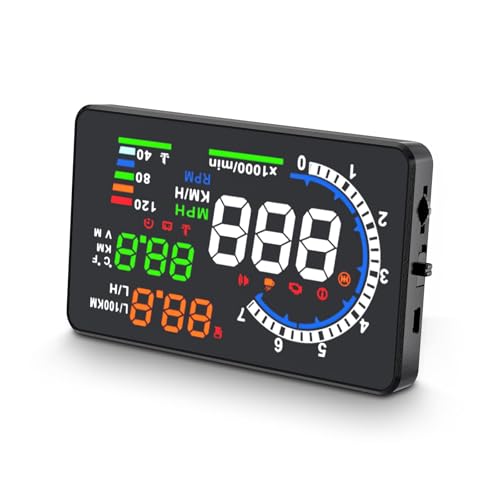
- Large 5.5-inch HD screen
- Displays speed, temperature, voltage, and distance
- Reads selected vehicle fault information
Best For: Compatible OBDII or EOBD vehicles needing more data
Best Diagnostic Value
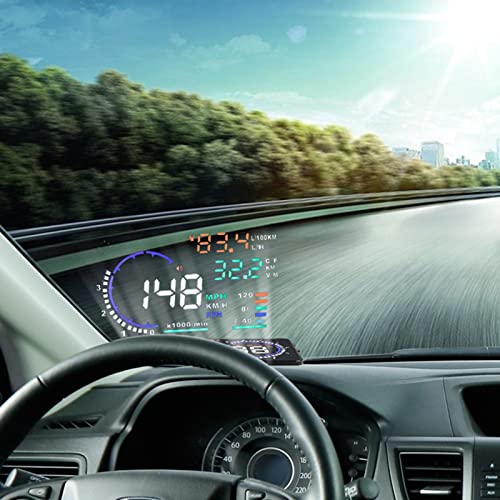
- Displays speed, engine, fuel, and mileage data
- Multiple safety and vehicle alerts
- Adjustable and automatic brightness
Best For: OBDII or EUOBD cars needing broad vehicle information
Best USB GPS Pick

- USB-powered with no OBD2 port required
- Large MPH display with auto brightness
- Dual-mode GPS+BDS positioning
Best For: Older cars with USB power but no suitable OBD2 connection
Best Multifunction Upgrade

- Large 5.5-inch HD projected display
- Shows speed plus key engine data
- Includes OBD2 diagnostics and alerts
Best For: Compatible OBD2 vehicles needing speed and engine information
Best Adjustable GPS Option

- USB plug-and-play installation
- MPH/KMH switching and speed calibration
- Custom overspeed alert with adjustable brightness
Best For: Drivers wanting a customizable GPS speed display
Best Plug-and-Play Pick – GPS USB HUD for Older Cars
For drivers comparing car head up displays for older cars, this USB-powered GPS model is a straightforward option when the vehicle lacks a compatible OBD-II connection. It displays speed in a large font, adjusts brightness automatically, and works with cars, trucks, and motorcycles that have a USB port.
Best For: Older vehicles with USB power but no usable OBD-II port, especially drivers who want a simple speed-only display.
Pros:
- USB plug-and-play design does not require an OBD port.
- Large MPH display with anti-reflective metal shading.
- GPS+BDS positioning, 10Hz refresh rate, and automatic brightness adjustment.
Cons:
- GPS speed can vary by approximately 0.6–1.8 MPH.
- Signal may be affected in tunnels, underground garages, heavy fog, or vehicles with metallic windshield film.
This is a practical choice when compatibility and readability matter more than advanced vehicle data. Its main limitation is that GPS performance depends on receiving a clear satellite signal.
Best OBD-II Value – Reflective 5.5-Inch Car HUD
This OBD-II model is worth considering among car head up displays for older cars when the vehicle supports OBD II or EUOBD. It connects through the diagnostic port, shows driving information on a reflective screen, and adds automatic ignition control and trip-mileage tracking.
Best For: Drivers with an OBD-II-compatible car who want a larger reflective display and basic mileage information.
Pros:
- Plug-and-play compatibility with most OBD-II or EUOBD vehicles.
- 5.5-inch reflective screen with nano-coating intended to reduce unwanted reflections.
- Automatic power on and off with the vehicle, plus trip-mileage measurement.
- Automatic and manual brightness modes.
Cons:
- Requires an OBD-II or EUOBD-compatible vehicle.
- Does not offer the USB-only installation flexibility of the GPS models.
If your older car has a working OBD-II port, this HUD offers a simple installation and useful trip information. Confirm the vehicle’s diagnostic-system compatibility before buying.
Best Feature-Rich Option – OBD2 and GPS Dual-System HUD
For shoppers seeking car head up displays for older cars with more than speed information, this dual-system unit combines OBD2 vehicle data with GPS functions. Depending on compatibility, it can show items such as RPM, water temperature, voltage, fuel consumption, and fault codes, while GPS mode provides speed and navigation-related data.
Best For: Owners of post-2008 OBD-II/EOBD vehicles who want diagnostic information, customizable alerts, and multiple display layouts.
Pros:
- Displays extensive OBD2 data, including speed, RPM, water temperature, voltage, and fuel consumption.
- Can scan and clear engine fault codes and read real-time data streams.
- Offers GPS backup functionality if the vehicle’s OBD2 protocol is incompatible.
- Includes adjustable speed, temperature, voltage, and RPM alerts.
Cons:
- Compatibility is limited to OBDII/EOBD vehicles generally produced after 2008.
- Listed exclusions include diesel, hybrid, RV, pickup, modified-computer vehicles, and several brands.
- GPS mode may be the only available function on an incompatible OBD2 system.
This is the most capable choice in the group, but also the one requiring the most careful compatibility check. It makes sense for drivers who will actually use diagnostic readings rather than only a projected speed.
Best Universal USB Design – Large-Font HUD with Safety Alerts
This universal USB model is a convenient contender among car head up displays for older cars because it requires only a USB interface and does not involve technical installation. It projects speed with large lettering, automatically adjusts brightness, and includes adjustable overspeed alerts for everyday driving, towing, or long trips.
Best For: Drivers wanting a low-profile, USB-powered speed display with large text, a built-in sun visor, and overspeed reminders.
Pros:
- Designed for vehicles equipped with a USB interface and powers on automatically with the engine.
- Large LED font, MPH/KMH switching, and automatic brightness adjustment.
- GPS+BDS positioning with a claimed accuracy within ±1 km/h.
- Includes three adjustable overspeed alert levels and a built-in sun visor.
Cons:
- Requires a USB interface for power.
- Its primary information is GPS-based speed rather than a broad set of vehicle gauges.
- Speed fine-tuning may be needed if the HUD reading differs from the vehicle display.
With universal USB compatibility and prominent safety alerts, this is a strong fit for drivers who prioritize easy setup and visibility. It is less suitable if you need OBD-based engine diagnostics or detailed vehicle metrics.
Best GPS Pick – Sun-Readable Universal HUD
For drivers comparing car head up displays for older cars, this universal GPS model is a straightforward option when you want speed information without relying on the vehicle’s diagnostic port. It tracks speed by GPS, supports MPH and KM/H, and is designed for 12V electric, hybrid, and gas vehicles.
Best For: Older vehicles and drivers who want a plug-and-play GPS speed display with safety alerts.
Pros:
- GPS speed tracking works across compatible 12V vehicles, including electric, hybrid, and gas models.
- 3000-lumen auto-adjusting display is designed for visibility in sunlight and at night.
- Includes overspeed and fatigue-driving alerts, plus six display modes.
- Installs through the car lighter port and turns on and off automatically.
Cons:
- Not compatible with 24V or higher heavy trucks.
- GPS-based information may offer fewer vehicle diagnostics than an OBD-connected display.
This is a practical choice if your older car lacks modern built-in display features. Its broad 12V compatibility and simple installation make it especially convenient, while the compact design keeps the setup unobtrusive.
Best Large-Screen Pick – Wiiyii A8 OBD HUD
This Wiiyii A8 is one of the more feature-rich car head up displays for older cars, provided the vehicle has OBDII or EOBD rather than OBD I or JOBD. Its 5.5-inch HD screen displays driving data and can also read selected vehicle information from the trip computer.
Best For: Owners of compatible OBDII or EOBD vehicles who want a large display with diagnostic-style data.
Pros:
- Large 5.5-inch, 800×480 display provides a clear viewing area.
- Shows speed, water temperature, voltage, distance, and alarm information.
- Supports kilometer and mile readouts.
- Can read vehicle fault information and includes failure alarm and clearing functions.
Cons:
- Compatibility is limited to OBDII and EOBD vehicles.
- Does not support OBD I or JOBD.
- Its supplied specifications include unusual media and connectivity listings, so buyers should verify fit before ordering.
The A8 stands out for drivers who want more than a basic speed readout. Confirming the car’s diagnostic standard is essential, but compatible vehicles can benefit from its larger screen and broader data display.
Best Diagnostic Value – Multi-Color OBDII HUD
For older cars equipped with OBDII or EUOBD, this 5.5-inch HUD combines speed projection with a wide selection of vehicle readings. It is aimed at drivers who want dashboard information in their forward view, along with configurable alerts for speed, fatigue, temperature, and voltage.
Best For: OBDII or EUOBD vehicle owners who want broad trip and engine information with multiple warnings.
Pros:
- Displays speed, engine speed, water temperature, battery voltage, fuel consumption, and mileage.
- Supports both KM/H and MPH.
- Offers adjustable brightness and automatic brightness control with reflection-reducing display technology.
- Includes overspeed, fatigue-driving, high-temperature, low-voltage, and shift reminders.
Cons:
- Only applies to vehicles using OBD II or EUOBD.
- Provides more information than a basic HUD, which may require extra setup or interpretation.
- The supplied details list two items while also stating a unit count of one, so package contents should be confirmed.
This model is a strong fit when an older car has the required diagnostic interface and you want a fuller information panel. Its alerts and automatic power behavior add convenience, while the compatibility requirement remains the main consideration.
Best USB GPS Pick – Large-Display Car HUD
For drivers comparing car head up displays for older cars, this USB-powered GPS model is a straightforward option when you want speed information without relying on an OBD2 port. Its large MPH display, automatic brightness adjustment, and simple plug-and-play setup suit vehicles with an available USB power source.
Best For: Older drivers and vehicles that lack a usable OBD2 connection but have USB power.
Pros:
- Uses dual-mode GPS+BDS positioning with a 10Hz refresh rate and support for up to 32 satellites.
- Large, anti-reflective speed display is designed for easy viewing, including while wearing sunglasses.
- Automatic brightness adjustment helps visibility in daytime and nighttime conditions.
- USB 5V plug-and-play power works with most cars, trucks, and motorcycles equipped with USB.
Cons:
- GPS speed can vary by about 0.6–1.8 MPH from the vehicle speedometer.
- Signal may be affected in tunnels, underground garages, heavy rain or fog, and by metallic windshield film.
This is a practical choice when compatibility and readability matter more than advanced vehicle diagnostics. It displays GPS speed only, so it is less suited to shoppers seeking engine data or OBD2 fault information.
Best Multifunction Upgrade – 5.5-Inch OBD2 HUD
Among car head up displays for older cars, this model stands out for combining a large 5.5-inch projected display with OBD2 vehicle data. It can show speed, RPM, water temperature, voltage, and fuel consumption, but compatibility depends on having a vehicle using OBD2 or EOBD protocols.
Best For: Drivers of compatible cars, SUVs, and trucks who want both a windshield speed display and additional vehicle information.
Pros:
- 5.5-inch HD screen provides a large projected readout with automatic brightness adjustment.
- Displays GPS speed in MPH or KMH along with RPM, water temperature, voltage, and fuel consumption.
- OBD2 functions include failure detection, alarms, and failure-code clearing.
- Plug-and-play installation is designed for vehicles with OBD2/EOBD protocols, widely used after 2003.
Cons:
- Requires a compatible OBD2/EOBD vehicle, so it may not suit some older cars.
- Its broader feature set makes it more involved than a basic USB GPS speedometer.
This is the most feature-rich option in the group, especially if you want useful engine readings in addition to speed. Confirm your car’s OBD2 compatibility before buying, since the unit depends on that connection for its expanded functions.
Best Adjustable GPS Option – Calibrated Car HUD
This GPS model is a useful choice for car head up displays for older cars when you want easy installation and more control over the readout. It connects through USB, switches between MPH and KMH, supports manual speed calibration, and adds a customizable overspeed alert.
Best For: Drivers who want a simple USB HUD with adjustable speed units, calibration, and speed warnings.
Pros:
- Dual-mode GPS+BDS reception, 10Hz refresh rate, and support for up to 32 satellites help provide responsive speed data.
- Manual speed calibration can help match the vehicle dashboard more closely.
- Switchable MPH/KMH display and multiple brightness levels support different driving preferences.
- Custom overspeed alerts add a useful reminder when a set limit is exceeded.
Cons:
- Requires USB 5V power and does not provide the OBD2 engine data offered by the multifunction model.
- GPS reception can be temporarily affected by tunnels, underground garages, heavy rain or fog, and metallic windshield film.
Its calibration and alert features make it a flexible alternative to a basic GPS display. Choose it when you value adjustable settings, while keeping in mind that GPS-based speed can still be affected by reception conditions.
How We Picked the Best Car Head Up Displays for Older Cars
We focused on compatibility with older vehicles, installation simplicity, display clarity, useful driving data, and the practical differences between GPS and OBD2 systems. GPS models are generally more universal because they do not depend on a compatible diagnostic port, while OBD2 units can provide additional information such as engine speed, coolant temperature, voltage, or fault alerts when the vehicle supports it.
We also considered windshield readability, adjustable brightness, speed-unit support, overspeed warnings, cable convenience, and whether the design is suitable for daily use. Claims such as fatigue alerts should be treated as supplemental reminders rather than a replacement for attentive driving.
Quick Comparison
| Type | Best for | Main advantage | Watch for |
|---|---|---|---|
| GPS HUD | Older or less compatible vehicles | Broad vehicle compatibility | May show fewer engine metrics |
| OBD2 HUD | Drivers wanting vehicle data | Access to diagnostic information | Port and protocol compatibility |
| USB HUD | Simple installation | Easy plug-and-play setup | Often limited to basic readings |
| Large-screen HUD | Users who prioritize visibility | More prominent projected information | Can occupy more dashboard space |
Key Buying Factors for Car Head-Up Displays for Older Cars
Compatibility and Power
Check whether the unit uses GPS, OBD2, USB, or a combination. GPS models are usually the safest choice for very old cars, imported vehicles, or cars with uncertain OBD2 support. For an OBD2 model, confirm that your vehicle has the required port and that the device supports its protocol. Also measure the cable route and check whether the power connector will interfere with other accessories.
Display Visibility
Look for adjustable brightness, clear numerals, and a projection surface that remains readable in both daylight and darkness. A larger screen can help drivers who need easier-to-read figures, but excessive brightness or reflections may become distracting. Position the projector so the display sits low in your normal forward view without blocking the road.
What Information Do You Need?
For basic speed monitoring, a GPS speedometer or simple USB HUD is often sufficient. Choose an OBD2 gauge display if you want tachometer, voltage, coolant temperature, fault information, or configurable alarms. Verify that the listed measurements are actually supported by your vehicle before buying.
Who Should Buy Which Car Head Up Displays for Older Cars?
- Choose a GPS model if universal compatibility and straightforward speed display matter most.
- Choose an OBD2 model if your older car supports the connection and you want engine-related data or diagnostic alerts.
- Choose a USB plug-and-play unit if you want the simplest setup with minimal configuration.
- Choose a larger multi-color display if visibility is your priority, especially when standard numerals are difficult to read.
Before installation, compare the displayed speed with your vehicle’s speedometer, secure the device and cables, and adjust the projection for minimal distraction. The best car head-up displays for older cars are the ones that match your vehicle’s connection type and provide only the information you can use safely.