If you want an OBD2 Scanner Diagnostic Tool review that focuses on everyday usefulness rather than gimmicks, this one is built around fast code reading, simple battery checks, and readable live data.
It is best for drivers, DIY mechanics, and small-shop users who need a straightforward scanner that can explain a check engine light without making the process complicated.
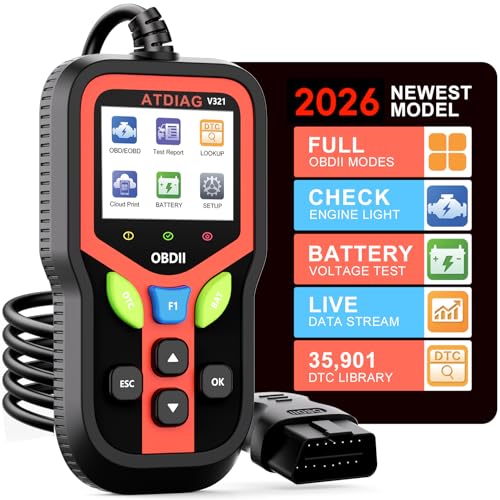
OBD2 Scanner Diagnostic Tool Review Summary
This OBD2 scanner makes sense for buyers who want a practical, no-drama diagnostic tool for modern vehicles.
The listing positions it as a plug-and-play reader for all OBDII vehicles since 1996, with a color display, cloud printing, freeze frame data, battery testing, and a broad fault-code library, so it leans toward convenience and breadth rather than advanced workshop depth.
Verdict: buy it if you want a simple diagnostic tool that covers the common jobs most drivers actually need. It should suit people who want to read and clear trouble codes, check readiness status, inspect live sensor data, and keep a compact scanner in the glove box or garage.
Review Scorecard
| Category | Score | Buyer assessment |
|---|---|---|
| Code reading and clearing | 8/10 | Reads and clears trouble codes, which covers the main reason most people buy a scanner. |
| Everyday diagnostics | 8/10 | Live data, freeze frame, I/M readiness, and EVAP testing make it more useful than a bare-bones reader. |
| Ease of use | 9/10 | Plug-and-play setup, shortcut keys, and a 2.4-inch color display help beginners get started quickly. |
| Vehicle compatibility | 8/10 | Supports standard OBDII vehicles since 1996 in the US, with broader regional compatibility listed. |
| Extra utility | 7/10 | Battery testing and cloud-based report printing add practical value beyond fault codes. |
| Durability and portability | 8/10 | The rugged silicone case and insulated cable suggest it is made for real-world use. |
Key Features and Specifications of OBD2 Scanner Diagnostic Tool
The core appeal of this OBD2 scanner is that it combines standard diagnostic coverage with a few extra convenience features that matter in real use.
According to the listing, it can read and clear trouble codes, check I/M readiness, view real-time sensor data such as RPM, coolant temperature, and fuel pressure, run EVAP tests, inspect battery health, and access freeze frame data.
It also includes a built-in library decoding over 35,901 fault codes.
That will not make it a professional-grade scan platform, but it does help if you want more context than a basic code reader can offer.
The compatibility claim is broad: most cars manufactured after 1996 in the US, 2000 in the EU, and 2008 in Asia that use a standard 16-pin OBD2 port.
That makes it relevant to a large share of mainstream passenger vehicles, though buyers should still verify compatibility before purchase.
Other listed features include:
- 10-language support, including English, Spanish, French, and Portuguese
- Shortcut keys for common tasks like report viewing, DTC reading, and battery testing
- Tri-color indicator lights for quick status feedback
- Cloud-based QR code printing for saving or sharing results
- A bright 2.4-inch color display
- A heat-resistant 3.0-foot insulated cable
- A rugged silicone case for protection
- Operating range from -22°F to 158°F
- Up to 24 hours of support across multiple vehicles
That feature mix makes the product look geared toward home mechanics, roadside troubleshooting, and light professional use, not deep OEM-level service work.
Pros and Cons of OBD2 Scanner Diagnostic Tool
Pros
- Broad OBDII compatibility for many vehicles since 1996 in the US
- Reads and clears codes, which is the essential function most buyers need
- Live data and freeze frame help with more informed diagnosis
- Battery testing adds value for general vehicle health checks
- Shortcut keys and color display should make it easier for beginners
- Cloud report printing can be useful for recordkeeping or sharing
- Rugged case and insulated cable suggest solid day-to-day usability
Cons
- It is still a standard OBD2 scanner, so buyers should not expect advanced brand-specific dealership functions
- The compatibility promise is broad, but vehicle-specific verification still matters
- The value depends on whether you will use the extra features, not just code reading
- Listing claims are strong on breadth, but they do not replace hands-on workshop comparison
The main tradeoff is clear: you get convenience, portability, and useful general diagnostics, but not the deeper control that comes with more specialized scan tools.
Who Should Buy OBD2 Scanner Diagnostic Tool?
This is a good fit for drivers who want a tool they can keep at home and reach for when a warning light appears.
If your goal is to identify the likely cause of a check engine light, clear a stored code after a repair, or confirm readiness before an inspection, this scanner is aimed directly at you.
It also makes sense for DIY owners who like to monitor live sensor data instead of guessing.
Fuel pressure, coolant temperature, RPM, and freeze frame data can all help narrow down a problem before parts get replaced.
Small-shop users may also appreciate the report printing and battery testing features, especially if they need a portable reader for quick checks on multiple vehicles.
You should probably skip it if you want a high-end diagnostic platform for module coding, bidirectional controls, or deep manufacturer-specific service functions.
The listing supports common OBDII diagnostic tasks, not full professional scan-tool workflows.
Diagnostic Depth and Usability of OBD2 Scanner Diagnostic Tool
Code Reading for Real-World Repairs
The strongest reason to consider this scanner is the practical fault-code workflow.
Being able to read and clear codes, check readiness, and access freeze frame data is enough for many routine troubleshooting jobs, especially when a warning light appears and you need a fast answer.
Live Data and Battery Checks
Live sensor data gives the scanner more diagnostic value than a simple code reader.
Pairing that with battery health testing is sensible, because a lot of common starting and drivability issues overlap with electrical problems rather than engine faults alone.
Report Sharing and Quick Navigation
The cloud QR printing feature is a useful touch if you want to save a diagnostic snapshot or share it with someone helping on the repair.
The shortcut keys also suggest that the interface is built to reduce menu-hopping, which matters if you are using it in a garage or driveway.
Durability for Garage Use
The rugged silicone case, insulated cable, and high/low temperature range are all small details, but they add up.
This is the kind of scanner that appears intended to live in a toolbox or glove compartment instead of being treated as delicate electronics.
Alternatives to OBD2 Scanner Diagnostic Tool
If you want a different balance of features or brand recognition, these are credible Amazon search alternatives:
FIXD is often considered by casual users who want a simpler app-led experience.
BlueDriver is a common step-up choice for buyers who want a more polished mobile workflow.
Autel and ANCEL cover a wide range of scanner styles, from basic readers to more capable tools, so they are worth comparing if you want to balance price, interface, and feature depth.
Is OBD2 Scanner Diagnostic Tool Worth It?
Yes, if your priority is practical everyday diagnostics. This OBD2 scanner looks worth it for buyers who want fast trouble-code reading, live data, battery checks, and easy vehicle compatibility without paying for workshop-grade complexity.
It is especially sensible for home mechanics, used-car owners, and anyone who wants a dependable first scanner rather than an advanced diagnostic platform.
If you only need a tool for occasional fault checks and basic vehicle health screening, this should be a useful buy.
If you need deep coding, specialized service features, or brand-specific diagnostics, look higher up the tool chain instead.