Jackery Explorer 240D Power Bank review is best understood as a compact power solution for people who want portable backup without moving up to a heavy, AC-first station.
If you are comparing a Jackery Explorer 240D Power Bank review against larger units, the key question is whether its DC-only, travel-friendly design fits your devices and routine.
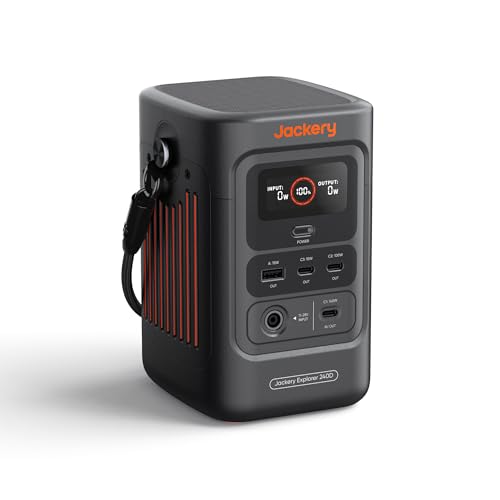
Explorer 240D Power Bank Review Summary
The Jackery Explorer 240D Power Bank is aimed at buyers who care more about grab-and-go utility than whole-home backup.
It pairs a 256Wh battery with 200W of pure DC output, a compact 4.9-pound build, and four output ports, which makes it a practical match for phones, tablets, cameras, small accessories, and other low-to-moderate power gear.
Verdict: strong for portability, smart for travel, and best for users who value fast replenishment over AC versatility. The listing also points to LiFePO4 battery chemistry, a claimed long service life, and multiple charging paths, which broadens its appeal for camping, road trips, emergency kits, and day-to-day carry in a vehicle or gear bag.
Review Scorecard
| Category | Score | Why it scores here |
|---|---|---|
| Portability | 9/10 | At about 4.9 pounds and a compact footprint, it is easy to carry and store. |
| Output Flexibility | 7/10 | Four ports and up to 140W per port are useful, but output is DC-only. |
| Battery Longevity | 8/10 | LiFePO4 chemistry and the stated cycle-life focus are strong durability signals. |
| Charging Convenience | 9/10 | USB-C strap cable, car, solar, and AC-DC input make recharging flexible. |
| Travel Fit | 8/10 | The size and weight suit outdoor, road, and emergency use well. |
| Device Compatibility | 7/10 | Good for many essentials, but buyers needing AC outlets should look elsewhere. |
| Value Proposition | 8/10 | The feature mix is focused and practical rather than overloaded. |
Key Features and Specifications of Explorer 240D Power Bank
The core spec sheet is straightforward.
The Explorer 240D Power Bank offers 256Wh of capacity, 200W of pure DC output, and four total ports: three USB-C ports and one USB-A port.
The listing says it can power up to four devices at once, with up to 140W per port, which gives it enough headroom for a mixed daily carry setup.
The unit is built around portability.
The product data lists a weight of 4.9 pounds and dimensions of 4.73 x 4.19 x 6.69 inches.
That is small enough to fit into a camping setup, a road-trip bin, or an emergency shelf without the awkward bulk that often comes with higher-output stations.
Another important detail is the battery type.
The listing describes an upgraded LiFePO4 battery with a claimed 10-year lifespan, 6,000-cycle durability, and the ability to retain at least 70% remaining energy after that cycle count.
Those are manufacturer claims, not lab validation here, but they are the kind of details buyers compare when they want a longer-term backup device.
Charging options are also a major part of the appeal.
The product data says it supports USB-C, solar, car charging, and AC-DC dual input.
With the 100W charger, the listing claims a 0% to 80% recharge in about one hour.
It also mentions up to 100W solar charging, which matters for campers and anyone preparing for outages.
Useful snapshot:
- Capacity: 256Wh
- Output: 200W pure DC
- Ports: 3 USB-C and 1 USB-A
- Weight: 4.9 pounds
- Dimensions: 4.73 x 4.19 x 6.69 inches
- Battery type: LiFePO4
- Charging inputs: USB-C, solar, car, AC-DC dual input
- Claimed fast charge: 0% to 80% in about 1 hour with a 100W charger
The included 2-in-1 USB-C strap cable is a practical touch.
According to the listing, it doubles as both a carry strap and a 140W fast-charging cable, which reduces clutter and makes the product feel more purpose-built for movement.
Pros and Cons of Explorer 240D Power Bank
Pros
- Very portable for its capacity. The size and weight make it easier to carry than many station-style alternatives.
- Good port mix for modern devices. Three USB-C ports and one USB-A port cover a lot of everyday charging needs.
- Flexible recharge paths. Solar, car, USB-C, and AC-DC input give it useful backup options.
- LiFePO4 battery chemistry. That is a strong sign for buyers who care about longer service life.
- Useful travel-oriented design. The strap cable and compact form support grab-and-go use.
Cons
- No AC outlet support. That limits use for appliances and anything that needs wall-style power.
- Capacity is moderate, not huge. 256Wh is enough for essentials, not for long off-grid living.
- Best for a narrow device class. If your kit depends on AC plugs, this is the wrong category.
- Claims depend on the charger used. The fast-charge promise is tied to specific input conditions.
Who Should Buy Explorer 240D Power Bank?
This Jackery Explorer 240D Power Bank review points to a clear audience: travelers, campers, commuters, and emergency planners who mainly charge USB-powered gear.
It makes the most sense if your load is phones, tablets, cameras, lights, and other low-power devices that benefit from compact backup power.
It is also a good fit if you want a device that can live in a car, closet, or go-bag without dominating the space around it.
The combination of 256Wh capacity, 4.9-pound weight, and multiple recharge options makes it feel practical rather than excessive.
You should probably skip it if you need to run AC appliances, medical devices that depend on wall plugs, or higher-draw electronics that go beyond 200W of DC output.
In that case, a larger Jackery unit or another portable power station with AC outlets will be a better category match.
It is also less compelling if you already own a larger station and only need occasional phone charging.
The 240D is more specialized than a general-purpose power bank, so its value comes from portability plus a broader output setup than a normal battery pack.
Charging and Portability Analysis
Everyday Carry Use
For routine carry, the Explorer 240D Power Bank stands out because it behaves more like a compact power station than an oversized battery pack.
The listed dimensions and weight suggest it can move with you instead of living in one place, which matters when you want backup power for travel days or field work.
Fast Recharge Scenarios
The charging story is one of the strongest parts of the listing.
A one-hour jump to 80% with a 100W charger is a meaningful convenience if you are between trips or recovering from a power outage.
Add solar and car charging, and the unit becomes easier to keep ready than a single-input backup.
Device Matching
The port layout tells you who this is for.
Three USB-C ports are the real center of gravity, while the single USB-A port covers legacy cables and smaller accessories.
That balance works well for modern mobile setups, but it also signals that this is not intended to replace an AC outlet station.
Long-Term Backup Value
LiFePO4 is the detail that matters most for buyers thinking beyond a weekend.
The listing’s cycle-life and lifespan claims position the product as something meant to stay in service for years, not just one season.
For an emergency shelf or travel kit, that kind of durability story is more useful than flashy peak-output marketing.
Alternatives to Explorer 240D Power Bank
If you want something in the same broad category but with a different balance of power and form factor, these are worth comparing:
The Jackery Explorer 300 Plus is the closest brand-to-brand comparison if you want to stay in the Jackery ecosystem.
Anker, BLUETTI, and EcoFlow are credible alternatives if you want to compare portability, charging speed, and output style across different product lines.
Is Explorer 240D Power Bank Worth It?
Yes, if your priority is compact backup power for USB-C devices and you want a light, travel-ready unit with flexible charging. The Jackery Explorer 240D Power Bank is worth considering because it combines portability, LiFePO4 construction, multiple input options, and enough output for everyday essentials.
It is not the right buy if you need AC outlets or a higher-capacity station for more demanding gear.
For the right user, though, it looks like a well-focused option that does what a compact power bank station should do: stay easy to carry, recharge in multiple ways, and keep essential devices running when you need them most.