FOXWELL BT705 is a serious answer to the question “is my battery actually healthy, or just acting up today?” If you want a guided FOXWELL BT705 car battery tester review from the buyer side, this one is best understood as a practical diagnostic tool rather than a gadget.
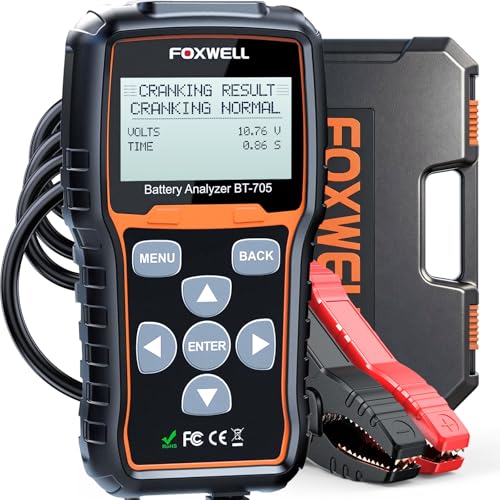
BT705 Review Summary
The FOXWELL BT705 makes sense for drivers, home mechanics, and small-shop users who want clear battery, cranking, and charging checks without having to decode every number themselves.
Its main appeal is not flash; it is the combination of guided screen prompts, broad 12V and 24V coverage, and a tester format that is built to be used repeatedly in a garage, driveway, or fleet setting.
For someone deciding whether the BT705 review should end with a purchase, the short version is this: it is a strong fit if you value actionable results like GOOD, RECHARGE, or REPLACE, want to check more than one vehicle type, and need enough cable reach to work alone.
It is less compelling if you only need an occasional basic voltage check or if you do not care about comparing battery health, cranking performance, and charging output in one tool.
Review Scorecard
| Category | Score | Editorial rationale |
|---|---|---|
| Guided usability | 9/10 | The 2.8-inch screen and step-by-step prompts reduce guesswork for first-time users. |
| Battery coverage | 9/10 | Supports 12V and 24V systems across 100-2000 CCA with multiple lead-acid battery types. |
| Starting-system checks | 8/10 | Cranking voltage and cranking time support meaningful start-up diagnosis. |
| Charging-system checks | 8/10 | Alternator and charging output testing adds value beyond simple battery health. |
| Single-person use | 8/10 | The 5.9 ft cable helps you stay at the wheel while reading results from the tester. |
| Storage and durability | 8/10 | The housing, clamps, and hard case make repeated use more practical. |
| Buyer breadth | 9/10 | Works for cars, trucks, RVs, boats, and commercial-style maintenance. |
Key Features and Specifications of BT705
The FOXWELL BT705 is built around a straightforward diagnostic workflow.
The listing says it checks battery health, cranking performance, and charging output, and it summarizes results in plain terms so the user can move from symptom to decision quickly.
Useful evidence-backed details include:
- Supports 12V and 24V systems.
- Covers 100-2000 CCA.
- Works with Flooded, AGM, GEL, and EFB lead-acid batteries.
- Intended for cars, pickups, trucks, RVs, boats, and commercial vehicles.
- Includes a 2.8-inch screen with step-by-step prompts.
- Uses a 5.9 ft test cable, which is long enough to reach from the battery area to the driver’s seat in many setups.
- Reports battery results as GOOD, RECHARGE, or REPLACE.
- Measures items relevant to startup and charging diagnosis, including CCA, voltage, internal resistance, SOH, cranking voltage, cranking time, and alternator/charging output.
- Comes with a protective housing, durable clamps, and a hard carrying case.
The title also matters.
This is not a vague battery accessory; it is positioned as a digital cranking and charging system analyzer, so the use case is broader than just “battery dead or not.” That matters if you maintain multiple vehicles or want to catch a weak battery before it strands you.
Pros and Cons of BT705
Pros
- Clear result language makes the tester easier to trust than a raw-number-only display.
- Broad vehicle coverage is useful for mixed garages and multi-vehicle households.
- 12V and 24V support makes it more flexible than many basic consumer testers.
- Long test cable helps with solo checks and reduces awkward positioning.
- Carrying case and clamps make it easier to keep organized between uses.
- Charging-system and cranking checks give it more diagnostic value than a simple battery meter.
Cons
- It is still a specialized diagnostic tool, so casual users may not need this much capability.
- The feature set is strongest when you are willing to follow prompts and interpret a full battery test workflow.
- If you only want a quick pass/fail read on one small vehicle battery, some buyers may see it as more tool than they need.
Who Should Buy BT705?
The FOXWELL BT705 fits buyers who want a single tester for battery health, cranking, and charging checks across more than one vehicle type.
It is a good match for DIY owners who maintain cars and trucks at home, RV or boat owners who need seasonal battery checks, and anyone who prefers plain-language results over a more technical meter-style readout.
It is also well suited to users who often work alone.
The cable length is a practical detail, not a marketing flourish, because being able to view the tester while starting the vehicle is a real convenience when you are trying to diagnose startup behavior.
You should probably skip it if your needs are very basic.
If you only want the cheapest possible way to see whether a battery has voltage, this is more instrument than necessity.
The BT705 review case for buying it is strongest when repeated use, wider compatibility, and clearer diagnosis matter more than keeping the tool minimal.
Battery Testing Workflow and Practical Use
Guided Results on the Screen
The BT705 is built to help the user move through a test rather than forcing them to guess the next step.
That makes it especially appealing if you are not already comfortable interpreting battery behavior, because the listing says the screen summarizes outcomes in terms like GOOD, RECHARGE, and REPLACE.
Starting and Charging Checks
A battery that reads okay at rest can still struggle during cranking, and a charging problem can make a healthy battery look bad later.
The value of this tester is that it is not limited to one snapshot.
It also checks startup behavior and charging output, which helps explain whether the issue is the battery itself, the starting load, or the alternator-side system.
Solo Use in a Driveway or Garage
The 5.9 ft cable is a practical feature for anyone who tests alone.
It lets the tester sit where you can read it while the vehicle is being started, which is exactly the kind of setup that makes this sort of tool more useful than a short-handled unit that requires an extra person.
Storage, Organization, and Reuse
The hard case and durable clamps suggest a tool meant to stay in rotation.
That matters for users who test several vehicles seasonally or who want one kit that can live on a shelf and be ready when a battery warning light, slow crank, or weak start finally appears.
Alternatives to BT705
If you want similar Amazon-available options, start with these search pages:
- NOCO Genius battery testers for buyers who prefer a well-known battery brand ecosystem.
- ANCEL battery testers for comparable automotive diagnostic options.
- TOPDON battery testers for shoppers comparing guided testers with broader vehicle support.
- Autel battery testers if you want a more established automotive diagnostic brand.
The best alternative depends on whether you care most about interface simplicity, vehicle range, or how much diagnostic depth you want beyond a basic battery check.
If the FOXWELL BT705 seems like the right balance of guidance and coverage, these alternatives are mainly there for comparison shopping rather than because the BT705 lacks a core use case.
Is BT705 Worth It?
Yes, the FOXWELL BT705 is worth it for buyers who want a guided battery tester with broader diagnostic reach than a simple voltage checker.
It is especially appealing if you maintain multiple vehicles, need 12V and 24V support, or want clearer battery, cranking, and charging conclusions in one tool.
If your use is occasional and simple, you may not need this much tester.
But if you want a practical, organized, and more informative way to check battery health before a bad battery becomes a no-start problem, the FOXWELL BT705 is a sensible buy.