BLUETTI Elite 300 review buyers usually want one thing: enough stored energy to cover real outages or RV needs without giving up too much space.
This model makes its case with a 3014.4Wh battery, 2400W output, and a compact footprint for a 3kWh-class unit.
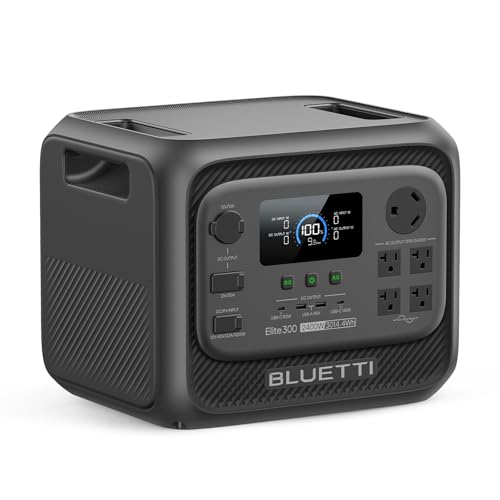
Elite 300 Review Summary
BLUETTI Elite 300 is a strong fit for buyers who want a serious portable power station for home backup, RV use, or a mixed setup that moves between the two.
The listing centers on capacity, output, compactness, RV-specific connectivity, and quick backup switching, so the value proposition is clear: it is built for practical power continuity rather than casual gadget charging.
What stands out most is the balance.
A 3014.4Wh LiFePO4 battery and 2400W continuous output put it in the territory where you can support essential household devices, not just phones and lights.
At the same time, BLUETTI emphasizes that the unit is nearly 59% smaller than traditional large power stations and identifies it as the world’s smallest 3kWh portable power station.
If that claim reflects your priorities, the Elite 300 is aimed squarely at you.
Review Scorecard
| Category | Score | Buyer rationale |
|---|---|---|
| Capacity for backup use | 9/10 | 3014.4Wh is large enough for meaningful outage planning and more than a short-run emergency pack. |
| Output capability | 9/10 | 2400W continuous and 4800W surge support heavier essential loads and startup demands. |
| RV practicality | 9/10 | TT-30 RV port and 12V/30A DC output are directly relevant to RV and camper use. |
| Compactness | 8/10 | BLUETTI positions it as unusually small for a 3kWh-class unit, which helps storage and transport. |
| Backup continuity | 8/10 | 10ms UPS switching is a meaningful feature for routers, computers, and home office gear. |
| Recharging flexibility | 8/10 | AC, solar, and car charging cover most real-world use cases, with fast AC recharge claimed. |
| Overall fit | 9/10 | Best for buyers who need serious portable backup power and value RV-ready design. |
Key Features and Specifications of Elite 300
Elite 300 is a portable power station centered on a 3014.4Wh LiFePO4 battery and a 2400W output rating, with 4800W surge support for resistive startup loads.
That combination is the main reason this product exists: it is meant to keep important appliances and devices running when smaller stations run out of headroom.
The listing also highlights several use-case-specific details that matter more than generic spec sheet numbers:
- TT-30 RV outlet for RV power systems
- 12V/30A DC output for higher-current 12V gear
- 10ms UPS backup switching for critical electronics
- App-based monitoring and output control
- AC, solar, and car charging support
- Claimed 0 to 100% recharge in as fast as 78 minutes
The battery chemistry is LiFePO4, which is a sensible choice for a product meant to live through repeated charge and discharge cycles.
That matters because a unit like this is not just for one-off emergencies; many buyers will want to keep it in rotation for storms, camping, job sites, or frequent RV travel.
From a physical design standpoint, BLUETTI is clearly leaning into space efficiency.
The listing says the Elite 300 is nearly 59% smaller than traditional large power stations and calls it the smallest 3kWh portable power station.
Even if you treat that as manufacturer positioning rather than a neutral benchmark, the message is important: this is not a bulky, awkward box that only works if you have a dedicated storage closet.
In practical terms, the feature mix suggests a product built around a few high-value priorities:
- Enough stored energy to matter during outages.
- Enough output to power real appliances and not just charge accessories.
- Enough portability and compactness to remain usable in an RV or mobile setup.
- Enough control and switching speed to serve as a backup source for sensitive electronics.
Pros and Cons of Elite 300
Pros
- Large 3014.4Wh capacity for serious backup planning
- 2400W output with 4800W surge for more demanding loads
- TT-30 RV port makes the unit more relevant for RV owners than generic stations
- 12V/30A DC output is useful for RV and off-grid equipment
- 10ms UPS backup is valuable for computers, routers, and home office gear
- AC, solar, and car charging broaden deployment options
- Compact positioning is attractive for storage and transport
Cons
- The feature set is optimized for serious use, so it may be more than some buyers need
- Heavy-duty capability usually means a higher commitment in weight, space, and budget planning, even when the unit is compact for its class
- The strongest value is in backup and RV scenarios; it is not especially compelling if you only want light, occasional charging
The biggest pros are not abstract.
They line up with the exact situations that push people toward a large power station in the first place.
The biggest con is equally clear: if your power needs are modest, the Elite 300 may be solving a bigger problem than you actually have.
Who Should Buy Elite 300?
Elite 300 makes the most sense for buyers who need portable power with real headroom.
That includes households preparing for outages, RV owners who want a more capable power source, and people who need a backup unit that can do more than keep a phone alive.
It is especially relevant if you care about:
- Running essential appliances during outages
- Keeping routers, computers, or home office gear online
- Supporting RV power systems with the right outlet and DC output
- Recharging from different sources depending on where you are
- Saving storage space compared with other large stations
It is less appealing if you are looking for a lightweight casual-use battery, a low-power weekend charger, or the cheapest way to get backup power.
The listing clearly pushes the Elite 300 toward buyers who will actually use the capacity and output, not people shopping for something decorative or occasional.
If you are trying to decide whether the Elite 300 is overkill, a good test is simple: do you already know which appliances or devices you want to run during an outage?
If yes, this unit starts to make sense.
If not, a smaller model may be more efficient.
Backup Power Planning for Elite 300
Capacity Matches Real-World Priorities
The 3014.4Wh battery is the core of the product, and it changes how you should evaluate the unit.
This is not a small backup brick; it is designed to cover meaningful loads, so the real question is whether your use case justifies that reserve.
For outage planning, that extra margin is what separates a convenience accessory from an emergency resource.
Output and Surge Headroom
2400W continuous output is a practical number because it expands the list of things the station can support.
The 4800W surge figure matters because many appliances need a stronger startup burst than their steady-state draw.
That makes the Elite 300 more credible for mixed household duty than lower-output alternatives that stall when a load spikes.
UPS Behavior for Sensitive Devices
The claimed 10ms UPS switch is one of the most useful features for desk setups and internet continuity.
If your goal is to keep a router, modem, or work computer from dropping during a brief outage, fast transfer matters more than flashy app controls.
This is a feature that directly serves continuity rather than convenience.
RV and Mobile Use
The TT-30 RV port and 12V/30A DC output make the Elite 300 more obviously RV-friendly than power stations that rely on generic outlets alone.
That matters because RV buyers often need outputs that match the way their systems are wired, not just a pile of AC sockets.
For travel use, the port selection is part of the value, not an accessory.
Alternatives to Elite 300
If you want to compare the Elite 300 against other credible Amazon-sold options, start with these product lines:
EcoFlow and Anker are the most natural comparisons if you want similar portable power station ambitions with strong ecosystem awareness.
Jackery is worth looking at if you want a widely recognized mainstream line, while Goal Zero is a long-running option for buyers who value established off-grid positioning.
The right comparison depends on what you care about most.
If you want RV-oriented outputs and compact 3kWh-class storage, Elite 300 has a distinctive angle.
If you want to compare app ecosystem maturity, accessory options, or different expansion approaches, the alternatives above are worth shortlisting before buying.
Is Elite 300 Worth It?
Elite 300 is worth it for buyers who need a compact but serious portable power station for outage backup, RV use, or mixed home-and-mobile power duties.
Its strongest case is the combination of 3014.4Wh capacity, 2400W output, TT-30 RV support, 12V/30A DC output, and 10ms UPS switching.
Buy it if you want one unit that can realistically handle essential backup tasks and still fit RV use cases. Skip it if your needs are light, occasional, or price-driven, because this product is built for people who will use its full capability.