When it comes to charging your electric vehicle, having the right cable can make all the difference. You want something that’s not only efficient but also versatile and safe. With so many options available, it’s essential to understand what each charging cable offers. Let’s explore the top 10 electric vehicle charging cables that can power up your ride effectively, ensuring you find the perfect match for your needs.
Portable Level 1 and Level 2 EV Charger for Electric Vehicles

When you’re looking for a versatile charging solution for your electric vehicle, the Portable Level 1 and Level 2 EV Charger stands out as the best choice for both home and on-the-go charging. With a NEMA 14-50 plug for Level 2 charging, it delivers up to 24 miles of range in just an hour, making it six times faster than standard Level 1 chargers. The 26-foot extension cable and durable design guarantee you can charge safely and conveniently. Plus, its LCD screen and safety features like leakage protection give you peace of mind while powering up your ride efficiently.
Best For: Electric vehicle owners seeking a portable and efficient charging solution for both home and travel.
Pros:
- Fast Charging: Delivers up to 24 miles of range in just one hour with Level 2 charging, significantly faster than standard Level 1 chargers.
- Versatile Compatibility: Comes with both NEMA 14-50 plug for Level 2 charging and NEMA 5-15 adapter for Level 1 charging, making it suitable for various situations.
- Safety Features: Equipped with leakage protection, overcharge protection, and under voltage protection for safe charging.
Cons:
- Dependence on Available Outlets: Requires access to compatible outlets for both Level 1 and Level 2 charging, which may not always be available in some locations.
- Length of Cable: While a 26-foot extension cable is convenient, it may still be insufficient for larger spaces or more distant charging points.
- Higher Initial Cost: The upfront cost may be higher compared to standard Level 1 chargers, which might deter budget-conscious buyers.
Level 2 Electric Vehicle Charger (32A, 25ft Cable)
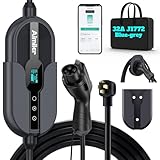
The Level 2 Electric Vehicle Charger with a 32A rating and a 25ft cable is an excellent choice for EV owners looking for efficient and rapid charging solutions. This charger delivers up to 7.68kWh, making it six times faster than Level 1 chargers. It’s compatible with most North American EVs and features a smart Wi-Fi app for monitoring your charging status. With adjustable amperage and a durable, military-grade cable, this charger is designed for reliable performance. Plus, its built-in safety features mean you can charge worry-free. Just remember, it requires a NEMA 14-50 socket for installation.
Best For: EV owners seeking a high-speed, reliable charging solution for their electric vehicles.
Pros:
- Fast Charging: Offers up to 7.68kWh, delivering charging speeds six times faster than Level 1 chargers.
- Smart Features: Includes a Wi-Fi app for monitoring charging status, cost, and history, enhancing user convenience.
- Durable Construction: Features a military-grade 25ft cable and built-in safety protections, ensuring long-lasting performance.
Cons:
- Installation Requirements: Requires a NEMA 14-50 socket for installation, which may require professional help.
- Limited Compatibility: Not compatible with Tesla vehicles without an adapter and excludes certain newer models.
- Weather Limitations: Not recommended for direct sunlight or rain due to its IP66 waterproof rating.
Level 1/2 Portable EV Charger with 25FT Cable

For those seeking a versatile charging solution, the Level 1/2 Portable EV Charger with a 25FT cable stands out as an ideal choice. It’s compatible with all J1772 electric vehicles, including brands like Tesla, Ford, and Nissan. With its NEMA 6-20 plug, you can charge at both 110V and 240V outlets, adding up to 12 miles of range per hour at 240V. Weighing just 8.38 pounds, it’s portable and water-resistant, making it perfect for home or travel. Plus, the built-in safety features guarantee your EV charges efficiently while maintaining battery health over time.
Best For: Those looking for a portable and versatile charging solution for their electric vehicles, particularly those with J1772 connectors.
Pros:
- Compatible with a wide range of electric vehicles, including Tesla with the appropriate adapter.
- Offers both Level 1 and Level 2 charging options, allowing for flexibility in charging speed.
- Lightweight and water-resistant design makes it easy to transport and use in various environments.
Cons:
- Requires a separate adapter for Tesla vehicles, which may be an additional cost.
- Charging speed is slower at 110V compared to 240V, which may not meet the needs of all users.
- The 30-day return guarantee might not be sufficient for those wanting to test it longer before committing.
EVIQO Level 2 EV Charger 40 Amp

Looking to charge your electric vehicle quickly and efficiently? The EVIQO Level 2 EV Charger, with a 40 Amp output, delivers a powerful 9.6 kW at 240V, ensuring you get back on the road in no time. Its 25-foot charging cord is compatible with all EVs and PHEVs in North America, and it even doubles as a Tesla home charger with an additional adapter. With a plug-and-charge design, installation takes just five minutes—no electrician needed! Plus, smart features like app controls and remote updates make managing your charging simple and convenient. Stay charged and ready to go!
Best For: Electric vehicle owners looking for a fast, efficient, and user-friendly charging solution at home.
Pros:
- Charges up to 8X faster than basic portable EV chargers, providing up to 38 mph charging speed.
- Easy 5-minute installation with no need for an electrician, thanks to the plug-and-charge design.
- Smart app controls allow for customizable charging settings and remote monitoring of energy consumption.
Cons:
- Requires a 240V NEMA 14-50 receptacle, which may not be available in all homes.
- The Tesla charging capability requires a separate NACS adapter, which is not included.
- While installation is easy, some users may prefer professional installation for added assurance.
EV Charger Extension Cable, 21ft 40Amp J1772 Compatible with EV Chargers

Need an efficient way to extend your EV charging reach? The EV Charger Extension Cable is your solution. At 21 feet long and compatible with J1772 EVs and PHEVs, this cable supports up to 40 amps and works with both Level 1 and Level 2 chargers. Its IP66 waterproof rating guarantees durability in various weather conditions. Featuring silver-plated inlets for superior conductivity, it also prevents overheating for safe charging. Plus, with a 12-month warranty and 24/7 customer support, you can charge confidently, whether at home or on the go. Don’t let distance limit your EV charging capabilities!
Best For: EV owners looking for an extended charging solution to enhance their charging flexibility at home or on-the-go.
Pros:
- Supports up to 40 amps for fast charging capabilities.
- IP66 waterproof rating ensures durability in various weather conditions.
- Includes a carrying bag for easy transport and storage.
Cons:
- May be too long for those with limited space for storage.
- Requires a compatible J1772 connector, which may not fit all EV models.
- Higher amperage may not be necessary for all users, potentially leading to overspending.
EV Charger Extension Cable (50Amp 20ft J1772)

The EV Charger Extension Cable (50Amp 20ft J1772) stands out as an essential accessory for electric vehicle (EV) and plug-in hybrid electric vehicle (PHEV) owners who require flexible charging options. This robust cable offers a maximum charging capacity of 50 amps, ensuring quick and efficient charging without power loss. Its 20-foot length provides added convenience, extending your charging range. With a waterproof IP66 rating and durable 100% copper TPE construction, it’s designed for everyday use. Plus, enjoy peace of mind with a 1-year manufacturer guarantee and 24/7 customer support for any operational questions.
Best For: Electric vehicle (EV) and plug-in hybrid electric vehicle (PHEV) owners seeking flexible and reliable charging options.
Pros:
- Delivers quick and efficient charging with no power loss.
- Durable construction with a waterproof IP66 rating for everyday use.
- Extended 20-foot length offers enhanced charging convenience.
Cons:
- May be too long for users with shorter charging needs.
- Requires compatible EV chargers to utilize the full 50-amp capacity.
- The 1-year warranty might be shorter compared to some other products.
Raylix Level 2 EV Charger (240V, 7.68kW)
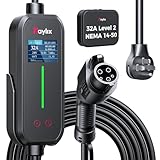
For electric vehicle owners seeking a powerful and efficient charging solution, the Raylix Level 2 EV Charger (240V, 7.68kW) stands out with its ultra-fast charging capabilities. You’ll enjoy charging speeds that deliver 34-39 miles of range per hour, making it twice as fast as standard chargers. The 21ft cable offers flexibility, while the charger’s compatibility with all SAE J1772 vehicles guarantees versatility. Safety features, like overcurrent protection, and its portable design enhance user experience. Plus, with a 2-year warranty and 24/7 customer support, you can rest easy knowing help is just a call away.
Best For: Electric vehicle owners looking for a fast, efficient, and versatile charging solution.
Pros:
- Ultra-fast charging speeds of 34-39 miles of range per hour, making it twice as fast as standard chargers.
- Compatible with all SAE J1772 electric vehicles and plug-in hybrids, ensuring versatility for various car models.
- User-friendly design with a built-in display and portable form factor, along with a 2-year warranty and 24/7 customer support.
Cons:
- Requires a dedicated 240V/40A circuit and specific NEMA 14-50 outlet for installation, which may not be readily available in all homes.
- Not compatible with certain outlet types (10-30, 14-30, or 6-50), limiting installation options.
- Tesla owners must purchase a separate adapter (J1772 to Tesla) for compatibility.
Level 1+2 Portable EV Charger with 21Ft Charging Cable

Ideal for electric vehicle owners seeking flexibility, the Level 1+2 Portable EV Charger with a 21FT charging cable offers the perfect solution for charging at home or on the go. This versatile charger works with both 120V and 240V outlets, delivering Level 2 charging that’s four times faster than standard options. With a robust weatherproof design and multiple safety features, it keeps you worry-free while charging. The lightweight build and included storage bag make it easy to transport. Plus, the LED indicators help you monitor your charging status, ensuring a seamless experience wherever you need to power up your ride.
Best For: Electric vehicle owners looking for a portable and versatile charging solution that works with both 120V and 240V outlets.
Pros:
- Supports both Level 1 and Level 2 charging for versatile use.
- Robust weatherproof design with multiple safety features for worry-free charging.
- Lightweight and portable with a convenient storage bag for easy transport.
Cons:
- Requires an adapter for Tesla vehicles, which may be an additional purchase.
- Charging speed may vary based on outlet type and availability.
- Not suitable for high-capacity fast charging needs compared to dedicated charging stations.
Level 2 Electric Vehicle (EV) Charger with 25ft Cable

Looking for a reliable and high-speed charging solution? The Level 2 Electric Vehicle (EV) Charger with a 25ft cable is your answer. With a 32A output and compatibility for all North American J1772 EVs and PHEVs, it charges up to 6X faster than Level 1 chargers. This ETL-certified unit features smart Wi-Fi capabilities for easy tracking and control via an app. Safety is prioritized with built-in leakage detection and NEMA Type 4 protection. Plus, the durable military-grade cable guarantees you can charge over 10,000 times. Upgrade your charging experience and power up efficiently!
Best For: Those seeking a fast, efficient, and reliable charging solution for their J1772-compatible electric vehicles or plug-in hybrids.
Pros:
- ETL certified and features smart Wi-Fi capabilities for easy monitoring and control.
- Charges up to 6X faster than Level 1 chargers, significantly reducing charging time.
- Durable 25ft military-grade cable allows for flexible charging options and longevity.
Cons:
- Requires a J1772 to Tesla adapter for Tesla vehicles, which is sold separately.
- Installation might require a professional electrician for a 240V NEMA 14-50 socket.
- Limited to North American J1772 EV and PHEV compatibility, excluding some international models.
Ceiling & Wall Mounted EV Charger Cable Retractor (11.5ft Automatic)

If you want a tidy and efficient way to manage your electric vehicle charging cable, the Ceiling & Wall Mounted EV Charger Cable Retractor is an excellent choice. This automatic retractor extends up to 11.5 feet and effortlessly retracts with just one touch, keeping your space organized. Its heavy-duty construction guarantees durability with over 100,000 retractions, while the UHMW-PE rope material assures strength. Compatible with 95% of EV plugs, including Tesla, it fits cables with diameters from 0.60 to 0.86 inches. Installation is flexible, reducing clutter and tripping hazards, making your charging experience safer and more convenient.
Best For: Individuals seeking a convenient and organized way to manage their electric vehicle charging cables while minimizing clutter and hazards.
Pros:
- Effortless One-Touch Retraction: Simplifies the process of storing cables with automatic retraction.
- Durable Construction: Built to last with heavy-duty materials, ensuring reliability over time.
- Wide Compatibility: Fits 95% of EV plugs, making it versatile for various electric vehicle brands.
Cons:
- Limited Cable Length: The maximum extension of 11.5 feet may not be sufficient for all installation scenarios.
- Installation Required: Users need to install the unit, which might be challenging for some individuals.
- Potentially Higher Cost: Compared to traditional cable management solutions, it may have a higher price point.
Factors to Consider When Choosing an Electric Vehicle Charging Cable
When choosing an electric vehicle charging cable, you need to take into account several key factors. Think about your charging speed requirements, the length of the cable, and the compatibility of the plugs. Don’t overlook the importance of amperage, voltage ratings, and safety features to guarantee a reliable charging experience.
Charging Speed Requirements
Choosing the right electric vehicle charging cable hinges on understanding charging speed requirements, which are influenced by factors like the charger’s amperage and voltage. Level 2 chargers typically deliver up to 7.68 kW, giving you around 24 miles of range per hour, while standard Level 1 chargers max out at 1.7 kW, providing only about 6 miles per hour. If you want quicker charging, adjustable amperage settings on Level 2 chargers let you choose between 16A and 32A, optimizing the speed to fit your needs. Remember, charging speed can also depend on the circuit’s capacity; higher-rated circuits (like 40A or 50A) allow for faster charging when compatible with your charger and vehicle. Choose wisely!
Cable Length Considerations
While it might seem straightforward, selecting the right cable length for your electric vehicle charger can considerably impact your charging experience. Standard lengths range from 16 to 25 feet, with longer cables, like those over 21 feet, providing more flexibility in positioning your vehicle at home or in public spaces. A 25-foot cable is especially advantageous for Level 2 chargers, as it can deliver faster charging speeds and accommodate various parking scenarios. Additionally, consider the charging location’s layout: longer cables help reduce tripping hazards and improve access to charging ports. However, keep in mind that longer cables may experience voltage drop depending on the charging amperage, so it’s essential to choose a length that aligns with your charger’s specifications for peak performance.
Plug Compatibility Types
Selecting the right electric vehicle charging cable goes beyond just cable length; plug compatibility is equally important. Most North American EVs and plug-in hybrids use the SAE J1772 connector. If you own a Tesla, you’ll need a J1772 to Tesla adapter to access common charging stations. When choosing a charging cable, consider the outlet type at your charging location. Level 1 chargers typically use a standard NEMA 5-15 plug for 110V, while Level 2 chargers often utilize a NEMA 14-50 plug for 240V. Additionally, ascertain the cable matches the amperage rating suitable for your needs, as higher amperage can lead to faster charging. Confirm compatibility with specific outlet types, like NEMA 6-20, to avoid frustrating charging experiences.
Amperage and Voltage Ratings
When it comes to electric vehicle charging cables, understanding amperage and voltage ratings is crucial for optimizing your charging experience. Amperage ratings typically range from 16A to 40A, with higher ratings allowing for faster charging speeds. Voltage ratings matter too; Level 1 chargers usually operate at 110V, while Level 2 chargers run at 240V, delivering notably quicker charging. For example, Level 2 chargers can provide up to 7.68kW at 32A, giving you about 24 miles of range per hour compared to just 6 miles with Level 1 chargers. Always verify your vehicle’s charging requirements match the charger’s amperage and voltage ratings to avoid inefficiencies and guarantee safe operation. Choosing wisely can make all the difference in your charging routine.
Safety Features Importance
Understanding amperage and voltage ratings is just one piece of the puzzle when it comes to choosing the right electric vehicle charging cable. You need to prioritize safety features like leakage protection and overcharge prevention to mitigate risks during charging. Look for cables with multiple safety protocols, including under-voltage and over-voltage protection, ensuring safe operation across different electrical systems. Consider IP ratings, such as IP66, which indicate resistance to dust and moisture, enhancing durability. High-quality cables use materials that prevent overheating and short circuits, essential for safe charging practices. User-friendly alerts and indicators provide real-time feedback on any potential issues, allowing you to address them promptly and greatly reduce the risk of accidents.
Weather Resistance Ratings
While you might focus on amperage and voltage when choosing an electric vehicle charging cable, don’t overlook the importance of weather resistance ratings. These ratings indicate how well a cable can handle exposure to rain, snow, and dust. For outdoor use, look for cables with an IP66 rating; this means they’re completely dust-tight and can resist powerful water jets. On the other hand, cables with lower ratings, like IP54, offer limited protection and are better suited for indoor or sheltered locations. Additionally, consider the material composition; high-quality TPE can enhance durability and weather resistance. By choosing a cable with a high weather resistance rating, you guarantee reliable performance and safety during charging, no matter the conditions.
Portability and Storage
Choosing the right electric vehicle charging cable isn’t just about technical specifications; portability and storage are key factors too. When you’re picking a cable, consider options like 25-foot and 21-foot lengths that offer flexibility for various charging locations. A lightweight design and included storage bags will make transporting and organizing your cable much easier. It’s also wise to look for cables with weatherproof ratings, like IP66, to guarantee they perform well outdoors. Many portable chargers come with adapters for different outlet types, giving you versatile charging options whether you’re at home or on the go. Finally, automatic retractable cable organizers can help keep your space tidy and reduce tripping hazards when storing your charging cables.
Installation and Maintenance Needs
When selecting an electric vehicle charging cable, it’s crucial to take into account installation and maintenance needs to guarantee peak performance. First, verify the cable is compatible with your vehicle‘s voltage and amperage, especially for Level 2 charging at 240V. You might need a dedicated circuit for higher amperage chargers, which could require hiring a qualified electrician. Also, consider the cable’s length; longer options, like 25ft, offer flexibility for various parking situations. Don’t forget to check for safety certifications like UL or ETL to confirm compliance with industry standards. Finally, assess the cable’s durability and weather resistance, as features like an IP66 waterproof rating can enhance its longevity in different conditions.