Working around brackets, tubing, automotive parts, or crowded fabrication areas calls for more than a standard grinder. The best angle grinders for tight spaces combine a compact head or body with controllable power, dependable safety features, and enough access to make accurate cuts or finish work.
These 10 picks include flathead cordless grinders, right-angle air die grinders, and mini battery-powered tools. Use the guide below to compare power sources, disc sizes, ergonomics, and the features that matter most when clearance is limited.
Best 10 Angle Grinders for Tight Spaces Picks for 2026
Best Flathead Cordless Pick
Milwaukee M18 FUEL Flathead Grinder

- Low-profile head reaches confined areas
- RAPIDSTOP brake stops wheels quickly
- Cordless M18 tool-only platform
Best For: Cordless users needing extra access in tight spaces
Best Compact Pneumatic Pick
Chicago Pneumatic CP875 Die Grinder

- 90-degree head reaches confined areas
- 22,500 RPM free speed
- Lightweight 0.99-pound design
Best For: Air-equipped shops doing maintenance, deburring, and polishing
Best DeWalt-Compatible Value
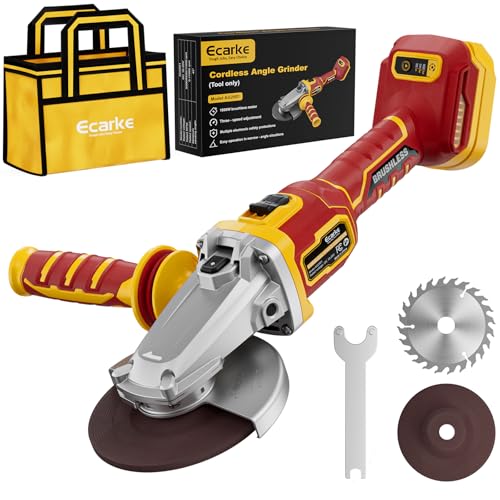
- Works with DeWalt 20V batteries
- 11,000 RPM brushless motor
- Tool-free guard and anti-vibration features
Best For: DeWalt users grinding in cramped corners and behind pipes
Best Heavy-Duty Air Option
Ingersoll Rand 3101G Die Grinder

- Right-angle access for confined work
- 0.33 HP motor reaches 20,000 RPM
- Self-locking throttle and rear exhaust
Best For: Automotive and fabrication work requiring steady pneumatic power
Compact Corded Pick
DEWALT DWE4011 4-1/2-Inch Angle Grinder

- Slim ergonomic body for maneuverability
- 12,000 RPM, 7-amp AC/DC motor
- Tool-free guard and wheel changes
Best For: Corded grinding and cutting in confined work areas
Precision Pneumatic Pick
WORKPRO 90-Degree Air Angle Die Grinder

- 90-degree head reaches angled spots
- 20,000 RPM with two collets
- Lightweight one-handed pneumatic design
Best For: Automotive and detail work with an air compressor
Best Compact Kit

- Compact one-hand design for cramped areas
- Two 2000mAh batteries included
- Six discs plus charger in the kit
Best For: Light home repairs, DIY cutting, and small outdoor jobs
Best High-Speed Mini

- 20,000 RPM no-load speed
- Compact 3-inch cordless format
- Dual batteries and protective cover
Best For: Fast, controlled DIY cutting in tight or off-grid locations
Best Flathead Cordless Pick – Milwaukee M18 FUEL Flathead Grinder
For cordless angle grinders for tight spaces, the Milwaukee M18 FUEL stands out with a low-profile flathead design that reaches areas a traditional 5-inch grinder may miss. Its paddle switch, 8,500 RPM motor, and RAPIDSTOP braking system make it a practical option for controlled cutting and grinding work.
Best For: Users who want cordless convenience and improved access in confined spaces, especially those already invested in Milwaukee M18 batteries.
Pros:
- Flathead design improves access behind obstructions and in narrow spaces.
- RAPIDSTOP brake stops most wheels in less than two seconds.
- Claims performance comparable to 11A corded power.
- Paddle switch provides convenient tool operation.
Cons:
- Tool-only package does not include a battery or charger.
- Its 8,500 RPM maximum speed is lower than some competing grinders.
This is a strong fit when reach and cordless portability matter more than maximum rotational speed. The flathead profile is the main reason to choose it over a conventional grinder.
Best Compact Pneumatic Pick – Chicago Pneumatic CP875 Die Grinder
The Chicago Pneumatic CP875 is a compact pneumatic choice among angle grinders for tight spaces. Its 90-degree head, 4.88-inch length, 0.99-pound weight, and 22,500 RPM free speed suit maintenance, deburring, polishing, and other detailed metalworking tasks.
Best For: Workshops and automotive or body-shop users with an air compressor who need a lightweight tool for confined-area grinding and finishing.
Pros:
- Compact right-angle head helps reach confined work areas.
- High 22,500 RPM free speed supports fast material removal and finishing.
- Safety throttle lever helps prevent accidental start-ups.
- Rear exhaust, aluminum housing, and composite over-sleeve support practical shop use.
Cons:
- Requires an air compressor and pneumatic setup.
- Its 1/4-inch collet is intended for die-grinder accessories rather than standard 5-inch grinder wheels.
The CP875 is particularly useful when compact dimensions and continuous air-powered operation are priorities. It is better suited to precision maintenance and deburring than broad surface grinding.
Best DeWalt-Compatible Value – Ecarke Flathead Grinder
The Ecarke Flat Head Grinder is designed for users seeking angle grinders for tight spaces within a DeWalt 20V battery ecosystem. Its extended flathead neck, 11,000 RPM brushless motor, anti-vibration design, and tool-free guard adjustment target difficult corners, edges, and areas behind pipes.
Best For: DeWalt 20V battery owners who want a flathead cordless grinder with high speed, vibration reduction, and convenient guard adjustments.
Pros:
- Compatible with DeWalt 20V batteries and uses a standard 5/8-inch arbor.
- Extended flathead design improves reach in cramped corners and behind pipes.
- Brushless motor reaches up to 11,000 RPM.
- Tool-free guard adjustment and two-position anti-vibration handle support workflow and comfort.
Cons:
- Battery and charger are not included.
- Overheat protection may place the tool in standby during prolonged heavy use.
- Compatibility is specified for DeWalt 20V batteries, not a universal battery system.
This model offers a feature-rich route into tight-space grinding for DeWalt battery users. Its heat-protection behavior is worth considering if your work involves extended, heavy-duty operation.
Best Heavy-Duty Air Option – Ingersoll Rand 3101G Die Grinder
The Ingersoll Rand 3101G is a right-angle pneumatic tool for angle-grinder work in tight spaces, including grinding, deburring, cutting, and polishing. Its 0.33-horsepower motor reaches 20,000 RPM, while the compact form and 1.3-pound weight help with maneuvering around hard-to-reach areas.
Best For: Automotive, fabrication, and garage users who need steady air-powered performance for detail grinding, polishing, and metal preparation.
Pros:
- Right-angle configuration improves access and maneuverability.
- 0.33-horsepower motor delivers up to 20,000 RPM.
- Self-locking throttle helps prevent accidental activation.
- Aluminum housing, ball bearings, rear exhaust, and reduced vibration support durable use.
Cons:
- Requires an air compressor, which is not included.
- At 1.3 pounds, it is heavier than the Chicago Pneumatic CP875.
- Uses a 1/4-inch collet, limiting it to compatible die-grinder accessories.
The 3101G is a practical pneumatic choice when consistent air power and durable construction are more important than cordless portability. Its right-angle layout makes it well suited to detailed work in restricted areas.
Compact Corded Pick – DEWALT DWE4011 4-1/2-Inch Angle Grinder
For angle grinders for tight spaces, the DEWALT DWE4011 combines a slim ergonomic body with a compact 4-1/2-inch format. Its 7-amp, 12,000-RPM motor is suited to faster material removal, while the adjustable guard and removable side handle help you manage access and control.
Best For: DIYers and tradespeople who want a compact corded grinder for cutting and grinding tasks where a slimmer body improves maneuverability.
Pros:
- Slim, ergonomic body supports comfort during extended use.
- One-Touch guard allows tool-free guard adjustment.
- Quick-Change wheel release enables wrench-free wheel removal.
- Two-position removable side handle adds control and flexibility.
Cons:
- Requires AC/DC power, so it is less convenient where outlets are unavailable.
- The 4-1/2-inch disc size may be limiting for larger jobs.
Choose this model when a slim corded design and straightforward wheel changes matter more than cordless portability. Its compact profile makes it a practical general-purpose option for tighter work areas.
Precision Pneumatic Pick – WORKPRO 90-Degree Air Angle Die Grinder
Among angle grinders for tight spaces, the WORKPRO air angle die grinder stands out for its 90-degree head and small one-pound body. Its 1/4-inch and 1/8-inch collets accommodate a range of bits for deburring, polishing, cutting, grinding, and shaping in hard-to-reach spots.
Best For: Automotive repair, welding cleanup, and detail work when you have a suitable air compressor and need a compact one-handed tool.
Pros:
- 90-degree head improves access to small or angled work areas.
- 20,000-RPM free speed supports precision grinding and polishing.
- Includes both 1/4-inch and 1/8-inch collets for broader bit compatibility.
- Lightweight 1-pound design and rear exhaust support one-handed operation.
Cons:
- Requires an air compressor, which is not included.
- Uses approximately 90 psi and 3 cfm, so compressor capacity matters.
- Air connections may require sealant tape to help prevent leaks.
This is the most specialized option here for narrow, angled access and fine material removal. It is a strong fit for compressor-equipped workshops, but less practical for users seeking a self-contained electric grinder.
Portable Mini Pick – SEESII 3-Inch Cordless Angle Grinder
For angle grinders for tight spaces without a power cord, the SEESII 3-inch cordless mini grinder offers a lightweight 1.85-pound design and one-handed operation. Its brushless motor reaches 19,000 RPM, and the kit includes two 21V 2.0Ah batteries plus discs for several light cutting and grinding tasks.
Best For: DIY users handling light work on metal, wood, stone, concrete, or ceramic indoors and outdoors where cordless mobility is useful.
Pros:
- Compact 3-inch format and lightweight body help with access and handling.
- Two batteries support extended cordless use and jobsite flexibility.
- Brushless motor delivers 210 watts and up to 19,000 RPM.
- Includes cutting, grinding, wood, and stone discs for varied light-duty tasks.
Cons:
- Its 3-inch discs are better suited to light work than larger cutting jobs.
- Battery charging is required for continued use.
- The supplied kit is relatively specialized around compact DIY tasks.
This model is a convenient choice when portability and a small footprint are priorities. The included batteries and discs make it ready for varied light-duty work, while overload, overheat, and cooling protections add reassurance during extended use.
Best Compact Kit – 3-Inch 16.8V Mini Grinder
For shoppers comparing angle grinders for tight spaces, this cordless 3-inch model emphasizes one-hand control and portability. Its 16.8V system, two 2000mAh batteries, and 19,500 RPM output suit light cutting, grinding, and trimming jobs around the home or outdoors.
Best For: Home DIY, light metal and wood work, corner repairs, and occasional tile trimming.
Pros:
- Compact 3-inch design supports work in cramped areas.
- Includes two batteries for swap-and-continue use.
- Comes with six cutting discs and a charger.
- Adjustable guard, spindle lock, and accidental-start protection add convenience.
Cons:
- Not recommended for heavy concrete, thick stone, or dense floor tile.
- Its compact format is intended for light-duty applications rather than demanding fabrication.
This is a practical starter kit when access and portability matter more than heavy-duty capacity. The included accessories make it ready for small repairs, while the dual-battery setup helps reduce downtime.
Best High-Speed Mini – 12V 20,000 RPM Grinder
This 12V cordless mini grinder is a useful option for angle grinders for tight spaces when you want a compact cutter with a high no-load speed. Its 3-inch format and ergonomic non-slip handle are designed for controlled work on metal, tile, wood, and PVC.
Best For: Precise DIY cutting, polishing rusty metal, PVC trimming, and renovation tasks away from outlets.
Pros:
- 20,000 RPM motor supports rapid cutting and material removal.
- Compact cordless body is suited to cramped or outdoor work areas.
- Two 12V lithium-ion batteries support extended projects.
- Protective cover, heat-dissipation vent, and spindle lock improve usability.
Cons:
- Only two cutting wheels are listed in the kit.
- The 12V platform may be better suited to compact DIY work than heavier jobs.
Choose this model if high speed and easy handling are priorities. It covers several common household materials and offers battery swapping for longer sessions, though the included accessory selection is relatively limited.
Best Safety-Focused Kit – TEENO 3-Inch Cordless Grinder
For angle grinders for tight spaces with a broader accessory package, the TEENO combines a slim 3-inch body with 19,500 RPM performance. Its one-hand design, dual batteries, adjustable guard, and two-button start are aimed at practical home repairs and compact workshop tasks.
Best For: Homeowners and DIYers cutting pipes, rusty bolts, and light metal or wood in confined areas.
Pros:
- 3-inch body and slim profile reach cramped plumbing and household corners.
- Two 16.8V 2000mAh batteries support quick swaps.
- Six starter discs, wrench, gloves, and case provide a well-equipped package.
- Two-button start and a 90-degree adjustable guard emphasize safety.
Cons:
- Listed weight is 3.7 pounds, which may be less nimble than lighter mini tools.
- The supplied details contain a voltage discrepancy, listing a 16.8V battery system but also 120 volts.
This kit stands out for its included accessories and safety-oriented controls. It is a versatile secondary tool for light cutting and grinding in restricted spaces, but buyers should verify the electrical specifications before purchasing.
How We Picked the Best Angle Grinders for Tight Spaces
We focused on tools that can reach confined work areas without sacrificing basic control or cutting performance. The selection includes compact cordless grinders, low-profile flathead designs, pneumatic right-angle tools, and small three-inch models. We considered head and disc size, overall maneuverability, speed, switch design, guard or braking features, battery compatibility, and the practical needs of metalworkers, mechanics, fabricators, and DIY users.
Because these tools use different power systems, no single specification determines the winner. A pneumatic die grinder may offer excellent access and sustained operation, while a cordless flathead grinder can provide more freedom around a jobsite. Mini grinders are especially useful for light cutting and detail work, but they generally should not be treated as replacements for full-size tools on demanding applications.
Quick Comparison
- Best for low-clearance grinding: A flathead cordless grinder, such as the Milwaukee or Ecarke style, places the disc closer to the work surface.
- Best for continuous shop use: A pneumatic right-angle or die grinder works well where a capable air compressor is available.
- Best for portability: Three-inch cordless mini grinders are easy to carry and useful for light cutting, trimming, and small repairs.
- Best for general-purpose value: A compact 4-1/2-inch grinder offers a wider range of compatible wheels and accessories.
Key Buying Factors for Angle Grinders for Tight Spaces
Head Size and Access
Measure the opening before choosing a tool. A three-inch grinder or slim flathead can fit where a conventional 4-1/2-inch grinder cannot, but the smaller disc also limits cutting depth and material removal. A die grinder with a one-quarter-inch collet is better for burrs, polishing points, and small abrasive accessories than for broad surface grinding.
Power Source and Runtime
Cordless models are convenient in vehicles, on ladders, and at unfinished jobsites, but runtime depends on battery capacity and workload. Check whether the tool includes batteries or is tool-only, and confirm compatibility with your existing battery platform. Air tools avoid battery charging but require a compressor with sufficient pressure, airflow, hose reach, and fittings.
Speed, Control, and Safety
High RPM helps small wheels cut efficiently, yet it also increases the importance of correct disc ratings and steady handling. Look for a manageable paddle or trigger, secure collet or spindle locking, a properly adjustable guard, and braking or overload protection where available. Always match accessories to the grinder’s rated speed and wear eye, hearing, hand, and respiratory protection appropriate to the work.
Ergonomics and Accessories
A narrow grip, low vibration, and balanced weight can matter more than peak speed in cramped positions. Check included discs, guards, wrenches, collets, batteries, and chargers before comparing prices; a less expensive tool may need additional accessories to become job-ready.
Who Should Buy Which Angle Grinders for Tight Spaces?
Choose a flathead cordless grinder if you regularly work behind brackets, inside frames, or along close-fitting metal surfaces. Choose a pneumatic die grinder for a workshop with reliable compressed air and frequent detail grinding. Choose a mini cordless grinder for occasional repairs, light sheet-metal cutting, hobby work, and maximum portability. Choose a conventional 4-1/2-inch model when you need broader accessory availability and more capacity than a mini tool provides.