If you want a straightforward OBD2 Scanner Car Code Reader review that focuses on real buying value, this model is best understood as a practical diagnostic starter tool.
It aims at drivers who want code reading, code clearing, and a few extra checks without a steep learning curve.
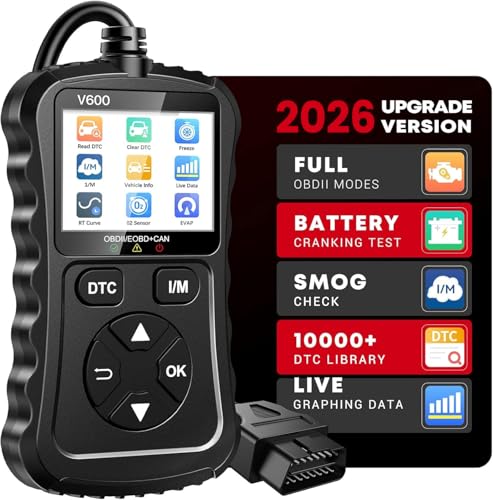
OBD2 Scanner Car Code Reader Review Summary
The case for this OBD2 scanner is simple: it bundles the basics most drivers actually need, then adds a few extras that make it more useful than a bare-bones fault-code reader.
It suits DIY owners, occasional troubleshooters, and small-shop users who want plug-and-play diagnostics with a clearer display and a voltage test function.
That said, it is not pitched as a deep specialist tool.
The listing emphasizes OBDII compatibility, common engine-code workflows, and a broad fault-code database, but it also makes clear that compatibility depends on the vehicle and that it cannot detect trucks or motorcycles.
If you buy it expecting universal coverage or advanced dealership-style functions, you will likely overestimate what it is for.
Review Scorecard
| Category | Score | Editorial rationale |
|---|---|---|
| Code reading and clearing | 8/10 | Built for read/clear workflows with shortcut keys and a large fault-code database. |
| Ease of use | 9/10 | Plug-and-play design, six buttons, and a simple layout point to low friction for beginners. |
| Compatibility breadth | 7/10 | Supports many 1996+ US cars and many EU/Asian vehicles, but not every vehicle class. |
| Extra diagnostic value | 8/10 | Real-time data, graphical analysis, freeze frame, MIL status, and I/M readiness improve usefulness. |
| Build and handling | 8/10 | Impact-resistant housing, flexible cable, and compact size suggest practical everyday durability. |
| Readability | 8/10 | The bright color screen should make on-device results easier to read in dim conditions. |
| Buyer confidence | 7/10 | Warranty and support help, though compatibility checks still matter before purchase. |
Key Features and Specifications of OBD2 Scanner Car Code Reader
This scanner is designed around standard OBDII use cases rather than exotic functions.
The listing says it supports reading and clearing engine error codes, real-time data streaming, graphical analysis, freeze frame viewing, MIL status checks, and I/M readiness monitoring.
For many owners, that is enough to move from guesswork to a structured diagnosis.
The standout feature is the added real-time voltage test.
That is a meaningful upgrade for a tool at this level because it lets you keep an eye on the vehicle’s electrical system while using the scanner.
The listing also mentions an enhanced chip intended to improve data processing and reduce waiting time, which should matter most when you want faster feedback during routine checks.
Important listed facts:
- Supports most 1996+ US cars.
- Supports over 2000 EU and Asian models.
- Works with SUVs and light trucks.
- Supports all OBDII protocols.
- Includes 10 languages, including English, German, Spanish, and French.
- Has a bright color screen.
- Uses 6 intuitive buttons plus dedicated I/M and DTC shortcut keys.
- Has a long, flexible cable.
- Built with impact-resistant materials and a non-slip housing.
- Includes a 90-day warranty and customer support.
There are also some useful limitations to note.
The listing says it cannot detect trucks or motorcycles, and it adds a compatibility note for Japanese car models manufactured after 2005.
It also warns that if a car is not repaired, a fault code may only be cleared by a computer at a 4S shop.
That last point matters because it reminds buyers that clearing a code is not the same as fixing the underlying issue.
Pros and Cons of OBD2 Scanner Car Code Reader
Pros
- Easy to use for first-time buyers. The plug-and-play design, shortcut keys, and straightforward button layout reduce setup friction.
- Useful feature mix for the price class. Real-time data, freeze frame, MIL status, and I/M readiness make it more than a one-function code reader.
- Voltage test adds practical value. Monitoring voltage can help you think about the electrical side of a fault, not just the stored code.
- Readable and portable. The compact body, flexible cable, and color screen make it easy to keep in a glove box or tool bag.
- Broad everyday-vehicle coverage. The stated support for many 1996+ US, EU, and Asian vehicles is a real selling point.
Cons
- Not a universal solution. The compatibility note means buyers still need to verify their exact vehicle.
- Not for motorcycles or trucks. That narrows the audience more than the general “all OBDII” language might suggest.
- Repairs still matter more than clearing codes. The listing itself says some faults cannot simply be cleared unless the problem is fixed.
- Advanced users may outgrow it. If you want deep brand-specific or pro-level diagnostics, this looks intentionally basic.
Who Should Buy OBD2 Scanner Car Code Reader?
This is a good fit for DIY drivers, used-car owners, and budget-conscious buyers who mainly want to read, clear, and monitor engine codes.
It also makes sense for someone who wants a compact scanner to keep in the car for occasional troubleshooting instead of buying a more expensive workshop tool.
It should also appeal to beginners who value simplicity over menus and configuration.
The dedicated shortcut keys, simple interface, and color screen suggest an experience built for quick checks rather than long sessions of device learning.
If your main goal is to confirm a check-engine light, inspect readiness status, or capture freeze-frame data, this product covers the common workflow.
Skip it if you need motorcycle support, truck support, or a high-end diagnostic platform.
The listing’s compatibility language is broad, but not broad enough to remove the need for vehicle checks.
It is also not the best choice if you want professional-grade service functions, deep module access, or a tool that can replace a shop-level scan platform.
Diagnostic Workflow on OBD2 Scanner Car Code Reader
Reading and Clearing Codes
The most important part of this scanner is still the core OBD2 workflow: identify the code, interpret it, and clear it after the repair.
The listing’s large fault-code database and DTC shortcut key should make that process faster than using a generic, no-frills reader.
For everyday ownership, that can turn a warning light from a mystery into an actionable next step.
Using Live Data and Freeze Frame
Real-time data streaming and graphical analysis are the features that help you move beyond a simple yes-or-no fault check.
Freeze frame viewing is especially useful because it preserves the conditions present when the fault was set.
That gives you more context when you are trying to understand whether a problem is intermittent, electrical, sensor-related, or tied to a specific operating state.
Voltage Testing and Electrical Checks
The real-time voltage test is the most clearly differentiated feature in the listing.
It will not replace a full electrical diagnostic setup, but it can still help you notice whether voltage behavior looks stable during a scan session.
For drivers who suspect battery or charging issues, that extra signal is genuinely useful.
Comfort, Display, and Everyday Handling
The physical design sounds built for the garage floor, glove box, or trunk.
A non-slip impact-resistant shell, flexible cable, and bright screen are not glamorous features, but they matter in the real world.
They make the scanner easier to hold, easier to read, and less annoying to use repeatedly.
Alternatives to OBD2 Scanner Car Code Reader
If you want to compare this against other familiar options, the most credible alternatives are usually the better-known scan tool lines on Amazon:
These are worth comparing if you want a different balance of app-based convenience, brand familiarity, or scan-tool depth.
The best choice depends on whether you care most about simple code reading, more advanced diagnostics, or a more established scanner ecosystem.
Is OBD2 Scanner Car Code Reader Worth It?
Yes, if you want a practical, beginner-friendly OBD2 scanner for everyday engine-code work. Its strongest case is the mix of straightforward operation, common diagnostic functions, voltage testing, and broad vehicle support for mainstream passenger vehicles.
It is less compelling if your use case is specialized, heavy-duty, or highly advanced.
But for a buyer who wants a compact code reader that can read, clear, and explain common check-engine situations without extra complexity, this looks worth considering.